
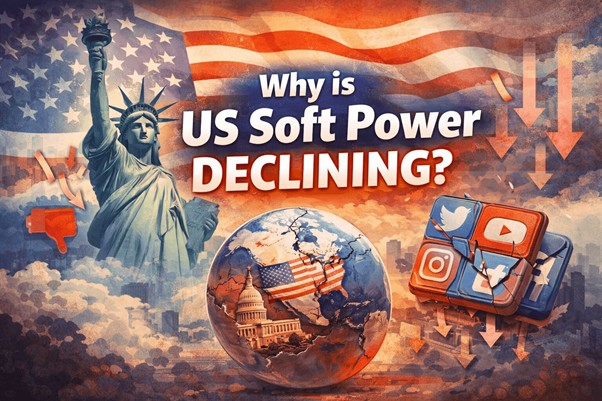
For decades, the United States has stood as a symbol of global leadership, shaping international politics, economics, and culture. Beyond its military and economic might, America’s influence has largely stemmed from its soft power—the ability to attract and persuade rather than coerce.
However, in recent years, questions have emerged: Is US influence declining? Has the global opinion of the United States shifted significantly?
From changing alliances to rising geopolitical competitors, the US reputation in the world is undergoing a noticeable transformation. This blog explores the concept of American soft power decline, the reasons behind it, and what it means for the future of global leadership.
What is American Soft Power? Understanding Its Global Influence
Soft power, a concept introduced by political scientist Joseph Nye, refers to a country’s ability to influence others through attraction, values, and culture rather than force or coercion.
Unlike hard power (military strength or economic sanctions), soft power relies on:
- Cultural appeal
- Political values
- Diplomacy and global engagement
Key Components of US Soft Power
The United States has historically dominated global soft power through:
- US cultural influence worldwide: Hollywood, music, fast food, and digital platforms have shaped global lifestyles
- Democratic values: Freedom, human rights, and governance models
- Educational leadership: Ivy League universities attracting international students
- Innovation and technology: Silicon Valley and global tech giants
Historical Strength of US Soft Power
After World War II, the US emerged as a global leader, promoting democracy and rebuilding economies. During the Cold War, it positioned itself as a model of freedom and prosperity.
At its peak, the US consistently ranked at the top of global indices, reinforcing its US soft power ranking as one of the strongest in the world.
Is US Influence Declining? A Global Perspective
Data and Trends in US Soft Power Ranking
Recent reports suggest fluctuations in the US soft power ranking, with other countries gaining ground. While the US remains influential, it no longer enjoys uncontested dominance.
Shifting Global Opinion of the United States
The global opinion of the United States has become more divided:
- Favorability has declined in parts of Europe and the Middle East
- Emerging economies show mixed perceptions
- Younger populations are increasingly critical
These shifts directly impact the US reputation in the world.
Trust in US Government Globally
One major concern is the declining trust in US government globally. Factors contributing to this include:
- Political polarization
- Policy inconsistency across administrations
- Perceived unpredictability in global decisions
Why is US Soft Power Declining? Key Factors Explained
US Foreign Policy Impact on Global Image
The US foreign policy impact on global image has been significant:
- Military interventions in Iraq and Afghanistan
- Withdrawal from international agreements
- Use of sanctions and unilateral actions
These actions have shaped global perceptions, often negatively.
Domestic Political Polarization
Internal divisions within the US are now visible worldwide. Political instability and polarization influence the global opinion of the United States, raising concerns about governance and stability.
Rise of Anti-American Sentiment Trends
There has been a noticeable rise in anti-American sentiment trends:
- Criticism of US interventionism
- Cultural resistance in certain regions
- Growing skepticism toward US leadership
Economic and Technological Competition
Global power dynamics are shifting. Emerging economies are challenging US dominance in trade, technology, and innovation.
Rise of China Soft Power vs US – A New Global Dynamic
China’s Expanding Global Influence
China has significantly expanded its global footprint through:
- The Belt and Road Initiative
- Infrastructure investments
- Strategic partnerships
Comparing Soft Power Strategies
The rise of China soft power vs US highlights key differences:
- China emphasizes economic diplomacy
- The US relies more on cultural and ideological appeal
Impact on Global Leadership Balance
This shift indicates a broader decline of American global leadership and the emergence of a more multipolar world order.
US Cultural Influence Worldwide – Still Strong or Fading?
Dominance of American Media & Technology
Despite challenges, US cultural influence worldwide remains strong:
- Hollywood and streaming platforms dominate entertainment
- Social media platforms shape global conversations
Global Adoption of American Lifestyle
American culture continues to influence:
- Fashion trends
- Language (English as a global medium)
- Consumer behavior
Challenges to Cultural Dominance
However, competition is rising:
- Korean pop culture (K-wave)
- Regional cinema and OTT platforms
- Cultural nationalism in various countries
US Diplomacy and Global Relations in a Changing World
The nature of US diplomacy and global relations is evolving:
- Shifting alliances
- Greater emphasis on multilateral cooperation
- Strategic partnerships in Asia-Pacific
Rebuilding Trust and Influence
Efforts are being made to rebuild:
- Global trust through climate agreements
- Diplomatic engagement and partnerships
- International collaboration
Future of US Global Leadership
The future of US leadership depends on:
- Consistent foreign policy
- Strengthening alliances
- Adapting to a multipolar world
What This Means for Students of American Studies
Importance of Understanding Global Perception
The debate around American soft power decline makes it essential to understand how global narratives are shaped.
Interdisciplinary Learning Opportunities
American Studies combines:
- Politics
- Economics
- Culture
- International relations
Career Scope in American Studies
Graduates can explore careers in:
- Policy analysis
- Diplomacy
- Media and communication
- Academia and research
Explore the Online MA in American Studies at JGU
The ma in american studies online offered by the Motwani Jadeja Institute for American Studies (MJIAS), O.P. Jindal Global University, is a comprehensive and globally relevant programme.
- Fully Online MA in American Studies
- Interdisciplinary and research-driven curriculum
- Global faculty and academic excellence
- Flexible learning for working professionals
Why Choose American Studies Masters Degree Programs?
These American Studies Masters Degree Programs provide:
- In-depth understanding of US politics, economy, and society
- Insights into global influence and diplomacy
- Analytical and critical thinking skills
- Students interested in international relations
- Professionals in policy, media, or global business
- Aspirants looking for careers in global studies
Conclusion
So, is US influence declining? The answer is complex.
While there are clear signs of American soft power decline, the United States continues to remain a powerful global force. Rather than a complete decline, what we are witnessing is a transformation in global power dynamics.
Understanding these changes is crucial for anyone interested in global affairs, policy, or international relations.
If you want to explore these dynamics in depth, enrolling in an Online MA in American Studies at JGU can provide the knowledge and perspective needed to navigate today’s evolving world.
FAQs
1. Is American soft power really declining?
Yes, there are signs of decline, but it is more accurate to describe it as a shift rather than a complete loss of influence.
2. What affects US reputation in the world?
Foreign policy, domestic politics, global events, and cultural influence all shape the US reputation in the world.
3. How does US foreign policy impact global perception?
The US foreign policy impact on global image can significantly influence trust and relationships with other countries.
4. What is the future of US global leadership?
The future depends on adaptability, diplomacy, and rebuilding global trust.