


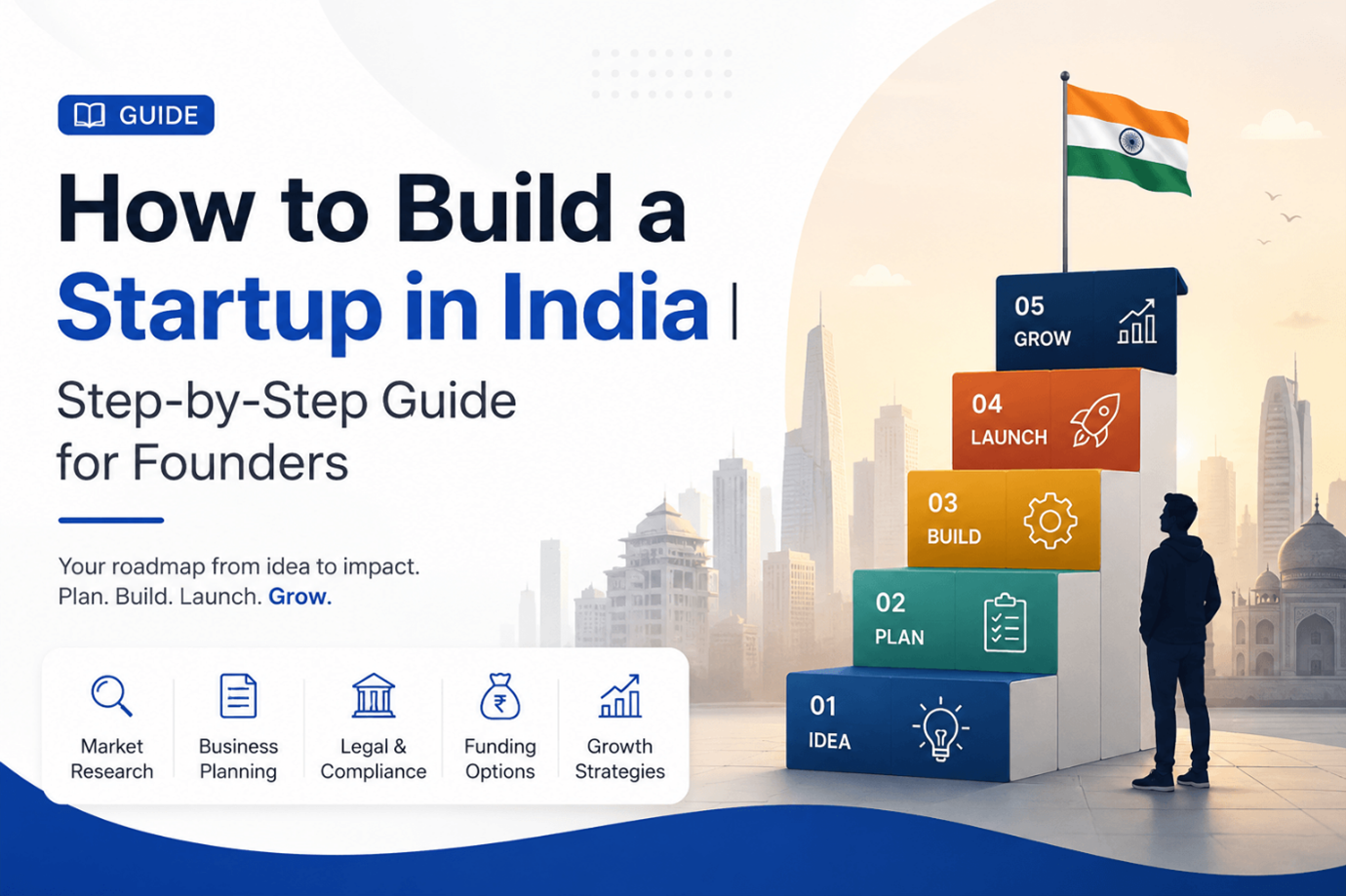
India is no longer the country where you "go abroad to build a startup." It is the place the world is watching. With over 2 lakh registered startups and 127 unicorns as of 2026, India sits firmly as the third-largest startup ecosystem on the planet.
If you are reading this, you are probably one of two people: a student with a notebook full of ideas, or a working professional quietly building a deck at 11 PM.
Either way, 2026 is a uniquely good year to start. The hype phase is over. Investors are writing fewer but larger cheques. Capital is flowing toward founders who can actually build.
This guide breaks down exactly how to start a startup in India in 2026 from idea to incorporation to your first cheque. No fluff. Just the sequence that works.
Why 2026 Is a Smart Year to Start a Startup in India
Let us start with the data, because numbers do not lie.
In FY 2025–26, Indian startups raised $11.7 billion an 18% dip from the previous year, but with a 33% rise in early-stage funding.
Translation: if you are a first-time founder building something real, capital is more accessible to you than to the late-stage growth-at-any-cost company next door.
A few signals that matter for 2026:
AI funding grew 58% year-on-year in 2025 and now makes up over 12% of total VC funding in India.
47 tech IPOs happened in FY26 — the highest in a decade. Exits are working again.
Deeptech, EV, climatetech, healthtech, and fintech are the sectors getting investor attention.
Government schemes like the Startup India Seed Fund Scheme (up to ₹50 lakh per startup) and the ₹10,000 crore Fund of Funds via SIDBI are actively deploying capital.
The takeaway? Investors want founders who understand both the building and the business. That is exactly why structured programmes like the Online M.Sc. in Entrepreneurship, Startups and Innovation from JGU Online have become so relevant they compress years of trial-and-error into a single year of structured learning.
Now, let us get into the actual playbook.
Step 1: Validate the Idea Before You Fall in Love with It
Most first-time founders skip this step. They build for six months, then realise no one wants what they built.
Do not be that founder.
How to validate cheaply:
1. Talk to at least 30 potential customers. Not friends. Real users.
2. Build a landing page in a weekend. Run ₹2,000 in ads. See if people click and sign up.
3. Pre-sell. If even five strangers pay you ₹100 before the product exists, you are onto something.
Startup Ideas in India 2026 Worth Exploring
If you are still hunting for direction, here are the sectors where founders are finding traction this year:
Applied AI tools for Indian SMBs invoicing, CRM, customer support in regional languages.
EV charging and battery-swap networks in Tier-2 cities.
Healthtech for Bharat - affordable diagnostics, tele-mental health, elder care.
Climate and energytech — carbon tracking, solar financing, sustainable packaging.
Vertical SaaS — software built for specific Indian industries like jewellery, logistics, or agri-trade.
Defence tech and spacetech — niche, but $311M was raised in H1 2025 alone.
Pick the one where your unfair advantage lives. Not the one with the loudest hype.
Step 2: Choose the Right Business Structure
This is where many founders make their first expensive mistake. Your business structure decides your taxes, your fundraising flexibility, and your liability.
For a typical Indian startup, you have three real choices:
Pro tip: If you plan to raise money or issue ESOPs to early hires, register as a Private Limited Company. VCs almost always prefer this structure because it allows equity issuance cleanly.
Sole proprietorships and unregistered partnerships are not eligible for DPIIT recognition, so avoid them if you want startup benefits.
Step 3: How to Register a Startup in India (The Actual Process)
Here is the no-nonsense sequence for registering your startup.
1. Incorporate Your Company
Go to the MCA portal and file the SPICe+ form. This single form handles:
Name reservation
Company incorporation
PAN and TAN allotment
GSTIN registration (optional)
EPFO and ESIC registration
Opening a bank account
Expected timeline: 7 to 15 working days if your paperwork is clean.
Documents you will need:
PAN and Aadhaar of all directors
Address proof of directors and the registered office
Digital Signature Certificate (DSC) for directors
Director Identification Number (DIN)
MoA and AoA drafts
2. Get a PAN, TAN, and Open a Current Account
These come bundled with SPICe+. Open a current account in your company's name at any major bank — most banks now offer zero-balance startup accounts.
3. Register for GST (If Applicable)
You need GST registration if your turnover crosses ₹20 lakh annually (₹10 lakh for special category states) or if you are selling across state borders.
4. Apply for DPIIT Recognition Under Startup India
This is the big one. DPIIT recognition is free and unlocks most of the benefits people associate with the Startup India scheme.
How to apply:
1. Visit startupindia.gov.in and create an account.
2. Go to "Get Recognised" and start the DPIIT application.
3. Upload your Certificate of Incorporation, PAN, a clear pitch deck, and a write-up explaining your innovation.
4. Submit. Approval typically arrives within 7 to 15 working days.
Eligibility (all five must be met):
Incorporated as a Private Limited Company, LLP, or Registered Partnership Firm
Less than 10 years old
Annual turnover under ₹100 crore in any year since incorporation
Working on innovation, improvement, or a scalable business model
Not formed by splitting up an existing business
A common reason for rejection?
A vague innovation write-up. Be specific about what makes your product different and how it scales.
Step 4: Understand Startup Legal Requirements in India
Once registered, the compliance clock starts ticking. Here is what you actually need to stay on top of:
Annual ROC filings with the Ministry of Corporate Affairs
Income tax returns (even if your revenue is zero)
GST returns monthly or quarterly, depending on your scheme
TDS deductions if you have employees or pay contractors above thresholds
Statutory registers — minutes of board meetings, share allotments, etc.
PF and ESI registration once your team crosses the threshold (currently 20 employees for PF)
Trademark and patent filings — DPIIT-recognised startups get 80% rebate on patent fees and 50% on trademark fees
Founder agreements matter more than you think. Before co-founders commit time and equity, put a vesting schedule and IP assignment in writing. Verbal agreements are how friendships and startups die together.
Step 5: How to Launch a Startup - Build Your MVP and First Team
Registration is just the paperwork. Now comes the actual hard part.
Build an MVP, Not a Product
A Minimum Viable Product solves one problem for one type of user. That's it. Skip the dashboard. Skip the loyalty program. Skip the dark mode.
Real-world example: Zerodha launched with a single feature — flat brokerage. Razorpay started by helping one small e-commerce site accept payments. Build small. Ship fast. Learn faster.
Hire Slowly, Fire Quickly
Your first 5 hires define your culture. A wrong senior hire in year one can kill your startup before product-market fit. Use trial projects. Pay for them. Watch how the person works before handing out equity.
Set Up the Tools
Operationally, you need: a payment gateway, accounting software, a CRM, basic analytics, and a communication stack. Most of these have free tiers for startups under the Startup India benefits.
Step 6: Startup Funding in India - How to Get Funding for Startup in India
This is the question every founder asks. Let us cut through the noise.
The Funding Stages (And What You Need at Each)
Where Indian Founders Actually Raise Money in 2026
1. Startup India Seed Fund Scheme (SISFS)
Government-backed scheme offering up to ₹20 lakh for proof of concept and prototype development, and up to ₹50 lakh for market entry and scale-up. Applied through DPIIT-recognised incubators.
2. Fund of Funds for Startups (FFS)
A ₹10,000 crore corpus managed by SIDBI. The fund invests in SEBI-registered VC funds, which then back DPIIT-recognised startups.
3. Angel Networks
Indian Angel Network, Mumbai Angels, LetsVenture, AngelList India. Expect ticket sizes of ₹25 lakh to ₹2 crore.
4. Venture Capital Funds
Sequoia (now Peak XV), Accel, Blume, Elevation, Lightspeed, Matrix, Stellaris, Kalaari — these are the active early-stage names.
5. Revenue-Based Financing
Newer players like GetVantage, Velocity, and Klub offer non-dilutive funding linked to your monthly revenue. Useful for D2C and SaaS startups.
6. Bank Loans Under CGTMSE
The Credit Guarantee Fund Trust offers collateral-free loans up to ₹2 crore for MSMEs and startups.
What Investors in 2026 Actually Look For
The grow-at-all-costs era is over. In 2026, investors care about:
Clear unit economics — you make money on every customer
Capital efficiency — how much you do per rupee
AI integration — startups using AI well are getting 2-3x higher valuations than peers
Sectoral expertise — they want founders who deeply understand their market
Defensibility — what stops the next person from copying you
This is exactly where structured education makes a difference. Programmes like JGU’s Online M.Sc. in Entrepreneurship, Startups and Innovation are built around these new investor expectations covering venture finance, business model design, and innovation strategy from people who have actually built and funded startups.
Step 7: The Complete Startup Checklist India (Save This Section)
Use this as your quick-reference list when you start:
Pre-Incorporation
Validate your idea with at least 30 customer conversations
Define your co-founder roles, equity split, and vesting schedule
Pick your business structure (Pvt Ltd recommended)
Incorporation
Reserve company name via SPICe+
Obtain Digital Signature Certificates
File incorporation documents with MCA
Receive Certificate of Incorporation, PAN, and TAN
Post-Incorporation
Open a current bank account
Apply for GST registration (if applicable)
Apply for DPIIT recognition on Startup India portal
Apply for Section 80-IAC tax exemption
File trademark applications for brand and logo
Operations
Set up accounting software and a CA on retainer
Draft employee contracts, NDAs, and offer letters
Build your MVP and launch to a small set of users
Set up analytics and customer feedback loops
Compliance Calendar
Monthly: GST returns, TDS payments
Quarterly: Advance tax (if profitable)
Annually: ROC filings, income tax return, audit (if applicable)
Common Mistakes First-Time Founders Make in India
Some are obvious. Most are not.
1. Choosing the wrong co-founder. Skill matches matter, but values matter more. If your co-founder cannot disagree with you respectfully, you have a ticking bomb.
2. Building in stealth. Talking to customers early is not "giving away the idea." It is the only way to know if anyone wants what you are building.
3. Skipping the founder agreement. A vesting schedule, IP assignment, and dispute resolution clauses written down protect everyone, including the friendship.
4. Raising too early. If you take money before you have signal, you give away equity cheaply and add pressure you cannot yet handle.
5. Ignoring compliance until something breaks. A missed ROC filing or an unpaid GST return can become a six-figure problem before you notice it.
6. Hiring senior people for cheap equity. A 1% mistake at seed becomes a 1% mistake at unicorn valuation. Pick carefully.
How Structured Learning Speeds Up the Founder Journey
Most successful founders share one thing: they have a strong mental model for how businesses work. Not just the idea. The model.
That mental model is what programmes like JGU’s Online M.Sc. in Entrepreneurship and Startups are built to develop.
Designed for working professionals and student-founders who want to build seriously, the M.Sc. in Entrepreneurship, Startups and Innovation at JGU Online covers everything from venture capital and design thinking to scaling strategy and innovation management taught by faculty and practitioners who have lived inside the startup world.
For first-time founders, the value is in the compression: instead of learning what works through ₹10 lakh of mistakes, you learn it through structured coursework, case studies, and direct mentorship.
The programme is fully online, which means you can keep your job or keep building your startup while you upskill.
Frequently Asked Questions (FAQs)
1. How much money do I need to build a startup in India in 2026?
You can incorporate a Private Limited Company for around ₹8,000 to ₹15,000 in government fees and another ₹10,000–₹20,000 in professional fees. The bigger costs come from product development, hiring, and marketing but a lean MVP in software can be built with under ₹2 lakh in initial capital.
2. Is DPIIT registration free?
Yes. There is zero government fee for DPIIT recognition under the Startup India scheme. The only costs are incidental like incorporation fees and any professional help you take.
3. How long does it take to register a startup in India?
Incorporation typically takes 7–15 working days. DPIIT recognition adds another 7–15 working days after that. So end-to-end, expect 3 to 5 weeks.
4. Can I build a startup while still studying or working a job?
Absolutely. Many founders begin their startup journey while still in college or while working full-time. Just make sure your employment contract does not have a non-compete or moonlighting clause that blocks you. Online programmes like the M.Sc. in Entrepreneurship, Startups and Innovation at JGU Online are designed specifically for this kind of dual-track journey.
5. What are the tax benefits for DPIIT-recognised startups?
DPIIT-recognised startups can claim a 3-year income tax holiday under Section 80-IAC (out of their first 10 years), exemption from angel tax under Section 56(2)(VIIB), and rebates on patent and trademark filing fees.
6. Do I need a co-founder?
Not legally, but practically yes, in most cases. Solo founders face higher burnout and slower decision-making. Most investors prefer to back teams of two or three with complementary skills.
7. Which sectors should I avoid in 2026?
Sectors with weak unit economics that depend purely on heavy discounting (think pure-play quick commerce without scale advantages, or low-margin marketplaces without network effects) are tougher to fund in 2026. Investors are sharply favouring profitability-first models.
8. How do I protect my startup idea legally?
Ideas themselves cannot be patented. But the execution can be protected through trademarks (for brand), patents (for technology), copyrights (for content and code), and NDAs (for confidential discussions). Start with a trademark for your brand name as soon as you incorporate.
9. Can foreign nationals build a startup in India?
Yes, with certain conditions. At least one director of the company must be an Indian resident. FDI rules apply for foreign investment, and some sectors have specific restrictions.
10. Is it better to learn entrepreneurship through experience or a degree?
Both. Experience teaches you what works in practice. A structured programme like the Online MSc in Entrepreneurship and Startups gives you the frameworks to make sense of that experience faster. Most successful founders rely on both.
Final Word: Start, Then Get Better
The honest truth about how to build a startup in India?
Nobody is ever fully ready. The founders who succeed are the ones who start with what they have, learn faster than everyone else, and adapt without ego.
India in 2026 has the capital, the talent pool, the policy support, and the consumer demand. What it needs is more first-time founders who treat building a company as a craft worth getting good at.
If you are serious about that craft, surround yourself with people who have done it.
Read widely.
Talk to customers more than to investors. And consider investing in your own learning whether through a structured route like JGU’s Online M.Sc. in Entrepreneurship, Startups and Innovation or through your own deliberate practice.
The best time to start was three years ago. The second-best time is the moment you finish reading this.