


Choosing the right academic path in the field of culture and heritage can shape not only your career but also the way you contribute to preserving history.
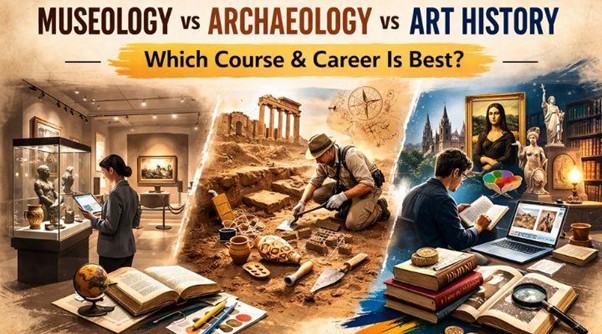
When students explore Museology vs Archaeology vs Art History, they often find overlapping themes—history, culture, art, and preservation but the career trajectories and skill sets differ significantly.
If you are passionate about heritage and wondering which discipline aligns best with your interests, this detailed guide will help you understand the differences, scope, and future opportunities in each field—especially in the context of India’s expanding cultural sector.
Understanding Museology: Beyond Museums
Museology, also known as Museum Studies, is the study of museums, their management, collections, preservation practices, and public engagement strategies.
It goes far beyond simply displaying artifacts—it involves storytelling, conservation, research, and audience interaction.
Museology Course Details
Comprehensive Museology course details typically include:
-
History and philosophy of museums
-
Curatorial studies and exhibition design
-
Heritage management
-
Conservation and restoration techniques
-
Documentation and digital archiving
-
Museum education and outreach
-
Cultural policy and ethics
The M.A. in Museology & Cultural Heritage at O.P. Jindal Global University (JGU Online) is an interdisciplinary programme designed to connect art, history, culture, and emerging technologies. The curriculum combines global theoretical frameworks with experiential learning through:
-
Site visits to heritage locations
-
Curatorial workshops
-
Conservation practices
-
Direct engagement at the Constitution Museum
-
Learning modules at the Rights and Freedoms Academy
For students seeking an Online M.A. in Museology & Cultural Heritage Management, this programme offers flexibility without compromising academic depth and practical exposure.
Understanding Archaeology: Discovering the Past
Archaeology is the scientific study of past civilizations through excavation, material remains, and field research. It seeks to reconstruct human history through evidence buried beneath the surface.
Fieldwork in Archaeology
One of the defining features of this discipline is Fieldwork in Archaeology, which includes:
-
Excavation of ancient sites
-
Surveying and mapping
-
Artifact collection and documentation
-
Scientific dating methods
-
Preservation of archaeological remains
Students who enjoy outdoor research, historical investigation, and scientific analysis may find archaeology deeply rewarding.
Career in Archaeology in India
A Career in Archaeology in India can involve:
-
Archaeological Survey of India (ASI)
-
State archaeology departments
-
Universities and research institutions
-
Cultural resource management firms
-
International excavation projects
Archaeologist Salary in India
The Archaeologist salary in India varies based on experience and institution:
-
Entry-level: ₹3–6 LPA
-
Mid-level professionals: ₹6–10 LPA
-
Senior researchers or consultants: ₹12 LPA and above
While archaeology offers intellectual fulfillment, it often requires extensive fieldwork and long research cycles.
Understanding Art History: Interpreting Visual Culture
Art History focuses on studying artistic movements, styles, cultural contexts, and influential artists across time. It is analytical, research-driven, and theory-oriented.
Art History Degree Scope
The Art History degree scope includes careers in:
-
Academia and research
-
Art criticism and journalism
-
Galleries and auction houses
-
Cultural consulting
-
Museum research departments
-
Art advisory roles
Students inclined toward critical thinking, visual analysis, and cultural theory may find art history to be an enriching academic path.
Difference Between Museology and Archaeology
The Difference between Museology and Archaeology lies primarily in their focus and work environment.
Museology
-
Focuses on museum operations and collections
-
Involves exhibition design and public engagement
-
Emphasizes heritage management
-
Specializes in conservation and restoration
-
Leads to roles like curator, collections manager, heritage consultant
Archaeology
-
Focuses on discovering historical artifacts
-
Requires excavation and field research
-
Emphasizes scientific analysis
-
Works primarily outdoors and in research labs
-
Leads to roles like archaeologist, excavation supervisor, heritage researcher
In simple terms, archaeology uncovers history, while museology preserves and presents it to the public.
Cultural Heritage Careers in a Changing World
The heritage sector is evolving rapidly with technology integration, policy reforms, and growing public engagement.
Modern cultural heritage careers now include:
-
Heritage management
-
Museum curator career path
-
Conservation and restoration specialists
-
Digital archive managers
-
Exhibition designers
-
Cultural tourism planners
-
Heritage policy advisors
With digital tools like AI, 3D scanning, and virtual reality transforming museum experiences, the scope of museum studies has expanded significantly.
Why Consider an M.A. in Museology & Cultural Heritage?
The M.A. in Museology & Cultural Heritage at O.P. Jindal Global University offers a future-ready approach to heritage education.
Interdisciplinary Learning
The programme integrates:
-
Art and visual culture
-
Historical studies
-
Cultural policy
-
Emerging museum technologies
-
Heritage management strategies
Experiential Exposure
Students gain hands-on exposure through:
-
Site visits and heritage immersion
-
Curatorial workshops
-
Practical conservation training
-
Engagement with live museum environments
Flexible Online Format
The Online M.A. in Museology & Cultural Heritage Management allows:
-
Working professionals to upskill
-
Students across India to access global faculty
-
Flexibility without compromising academic rigor
For those seeking a structured museum curator career path, this programme builds both theoretical and practical competencies.
How to Choose the Right Path?
Ask yourself the following:
-
Do you enjoy scientific exploration and excavation? → Archaeology
-
Are you interested in managing museums and shaping exhibitions? → Museology
-
Do you love analyzing artistic movements and cultural symbolism? → Art History
If you prefer a blend of research, management, creativity, and technology, museology offers diverse opportunities in heritage management and conservation and restoration.
Frequently Asked Questions (FAQs)
1. What is the main difference between Museology and Archaeology?
The Difference between Museology and Archaeology is that archaeology focuses on discovering historical artifacts through fieldwork, while museology focuses on preserving, interpreting, and exhibiting those artifacts in museums.
2. What is the scope of an Art History degree?
The Art History degree scope includes careers in research, academia, galleries, auction houses, museums, and cultural journalism
4. What are the Museology course details at JGU Online?
The Museology course details include museum management, heritage management, conservation and restoration, curatorial practices, digital archiving, and experiential learning components.
Final Thoughts
The debate around Museology vs Archaeology vs Art History ultimately comes down to your interests, work style preferences, and career aspirations.
If you envision yourself shaping how history is experienced by future generations—while combining theory, technology, and practice—the M.A. in Museology & Cultural Heritage at O.P. Jindal Global University offers a dynamic and future-oriented pathway into the world of museum studies and heritage management.