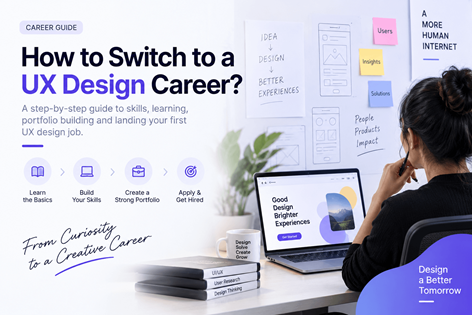
How to Switch to a UX Design Career: Complete Step-by-Step Guide
A career switch to UX design has become one of the most common professional moves in India today. Engineers tired of shipping features nobody uses, marketers who understand customers but never shape the product, and architects trained to design for human behaviour are all arriving at the same destination: user experience design.
Here is the encouraging part. None of them start from zero. UX rewards structured thinking, empathy, research and communication, and you have already built several of these at work. This guide covers what transfers from your field, which UX designer skills to learn first, and how long a realistic transition takes.
Key Takeaways
- You do not need a design degree, but you do need a portfolio that shows how you think.
- Engineering, marketing and architecture each transfer a distinct strength into UX.
- A realistic transition takes 9 to 18 months alongside a full-time job.
- Research, information architecture, interaction design and Figma are the first skills to build.
- A structured postgraduate qualification adds credibility, mentorship and live industry projects.
What Does a Career Switch to UX Design Actually Involve?
A career switch to UX design means moving into a role where you research user needs, structure information, design interfaces and test those decisions. Figuring out how to become a UX designer from another field comes down to three things: learning UX methods, building a portfolio of real problems, and repositioning your existing experience as design experience.
Only one of those is about tools. Most people who stall spend their time on software tutorials and none on the reasoning hiring managers assess.
Why Professionals Are Moving into UX Design
Digital products in India now compete on experience, not features alone. Banking apps, health platforms, B2B dashboards and AI tools all need people who can make complexity feel simple. According to the Master of Design in User Experience programme page at O.P. Jindal Global University, demand for UX professionals continues to outpace the supply of qualified experts.
Who Should Consider This Move?
- Software developers, testers and engineers who want influence over what gets built.
- Marketers, content specialists and product managers who already think in customer behaviour.
- Anyone planning a career change into design in India without restarting at entry level.
Can I Switch to UX Design Without a Design Background?
Yes. UX design for non designers is a well-established path because UX is a problem-solving discipline before it is a visual one. Employers assess whether you can identify a real user problem, justify your decisions and communicate them clearly. Two or three deep case studies matter more than your undergraduate degree.
Visual fundamentals still cannot be skipped. Typography, hierarchy, spacing and colour are learnable, and they are usually the first gap self-taught switchers must close.
Which Skills Transfer from Engineering, Marketing and Architecture?
Every field brings a different advantage. Naming yours clearly is the most useful thing you can do for your applications.
Software Engineer to UX Designer
A software engineer to UX designer move starts with a real advantage: systems thinking, an eye for edge cases and fluency in constraints. You know what is expensive to build, which makes your designs realistic and your handoffs efficient. Engineers also pick up design systems fast. The gaps to close are user research, ambiguity tolerance and visual craft.
Marketing to UX Design
Marketers bring audience empathy, an instinct for messaging and comfort with data. Funnel analysis maps neatly onto user journeys, and A/B testing translates into usability validation. The main shift is from persuading users to serving them. Your gaps are interaction design, prototyping and information architecture.
Architecture to UX Design
Architects may have the smoothest conceptual transition. You already design for how people move through space and present concepts to demanding stakeholders. Wayfinding in a building is the physical cousin of information architecture in an app. Your gaps are digital tooling, interaction patterns and the faster iteration rhythm of product teams.
UX Designer Skills to Learn First
Learn these in order.
- User research: interviews, surveys and turning observations into insights.
- Information architecture: structuring content and navigation so users find things without effort.
- Interaction design: flows, states and error handling.
- Visual fundamentals: layout, typography, colour and accessible contrast.
- Prototyping in Figma: components, auto layout and interactive flows.
- Usability testing and design communication: run sessions, then defend the rationale.
- AI in design: use AI to accelerate execution, and design AI-powered interfaces responsibly.
How Long Does It Take to Transition into UX Design?
Most career switchers need 9 to 18 months to become job-ready while working full time. Roughly four months goes into fundamentals, six into portfolio projects, and the rest into applications and interviews. A structured postgraduate route can compress this to around 12 months. The variable that matters most is not talent, but consistency plus feedback from practising designers.
A Practical Roadmap for a Career Change into Design in India
- Audit what you already have. List every project where you solved a human problem or simplified a process. This becomes your interview narrative.
- Build the missing fundamentals. Redesign products you use daily and write up the reasoning, not just the screens.
- Get real projects, not exercises. Volunteer for design work at your company, help a startup, or join an apprenticeship. Live constraints beat speculative app redesigns.
- Build a portfolio that shows thinking. Show the problem, your research, discarded options and outcomes.
- Get feedback from working designers. Critiques and mentorship shorten the curve, and this is what self-taught switchers lack.
Common Misconceptions About Switching to UX
- "I need to draw well." You need to communicate ideas clearly. Rough wireframes plus sound reasoning beat beautiful screens with no logic.
- "I will have to start over at entry level." Domain expertise is an asset. Fintech engineers and healthcare marketers are valuable to teams in those sectors.
- "AI will replace UX designers." AI accelerates execution. Designers who use it well move faster into leadership roles.
Career Opportunities After Switching to UX Design
Destination roles include UX Designer, Product Designer, UX Researcher, Interaction Designer and AI Experience Designer. With experience, paths open into UX Lead, Design Manager and Head of Design.
The Master of Design in User Experience lists three outcomes: access to high-paying roles in leading design firms and technology companies, leadership skills for managing teams, and a professional brand that stands out.
A Structured Route: Master of Design in User Experience from JGU Online
Self-teaching works, but it is slow. A formal qualification helps when you need credibility, mentorship and real projects at once.
The Master of Design in User Experience from JGU Online is a 12-month, 58-credit degree from the Jindal School of Art and Architecture, built with Silicon Valley-based UXReactor. It is delivered online with a 9-day campus immersion, includes 200+ hours of live learning, and carries dual certification from JGU and UXReactor.
It names career switchers as one of its four target groups. The curriculum spans systems thinking and AI foundations, product critique, UX tool mastery, interaction design, visual design and research, with 10+ industry projects and two apprenticeships
Eligibility and Selection Criteria
Per the programme page, eligibility is a bachelor’s degree with 50% marks. It is curated for:
- UI/UX designers and professionals seeking to elevate their careers.
- Software developers and testers aiming to shift into design roles.
- Graphic designers, architects, motion designers and animators targeting UI/UX or product design.
- Design enthusiasts wanting to learn AI in design, and entry-level designers seeking credibility.
The application runs in five steps. Total tuition is Rs. 5,50,000, payable in instalments, with merit and need-based scholarships available. Verify current fees and dates on the official programme page.
Frequently Asked Questions
Can I switch to UX design without a design background?
Yes. UX is a research and problem-solving discipline, so professionals from engineering, marketing, architecture and business transition successfully every year. You will need visual fundamentals and case studies that show your reasoning, but a design degree is not required for most roles.
How long does it take to transition into UX design?
Plan for 9 to 18 months of part-time effort while working, or around 12 months through a structured postgraduate programme. The timeline depends on how quickly you build a credible portfolio and how much expert feedback you get.
Which skills transfer from engineering to UX design?
Systems thinking, logical structuring, awareness of technical constraints, a debugging mindset and collaboration with development teams all transfer directly. Engineers also learn design systems quickly. The skills to build are user research, visual craft and comfort with ambiguity.
Is a UX design degree necessary to get hired?
Not mandatory, but it helps when you are switching from an unrelated field, want mentorship and live industry projects, or need a formal postgraduate credential.
Ready to Make the Switch?
A career switch to UX design is less about starting over than redirecting what you already know. Engineers bring structure, marketers bring empathy, architects bring spatial reasoning. What most switchers need is a system, real projects and expert feedback.
If you want that in one place, explore the
Master of Design in User Experience from JGU Online. Download the brochure or speak to an admissions counsellor to check your eligibility.