


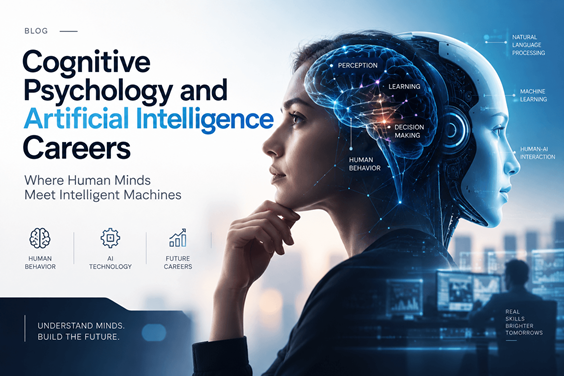
Cognitive Psychology & Artificial Intelligence Careers: Skills & Jobs
Ask yourself why one app feels effortless while another leaves you confused. The answer usually has less to do with code and more to do with the mind. The link between cognitive psychology and artificial intelligence sits at the centre of every product that reads, recommends, predicts or responds. Cognitive psychology studies how people perceive, remember, learn and decide.
Artificial intelligence attempts something similar using data. When the two fields meet, technology stops being merely powerful and becomes genuinely usable. Here is what that means for your career.
Key Takeaways
- Cognitive psychology explains how humans think; artificial intelligence models comparable processes in machines.
- Core AI concepts such as reinforcement learning and attention mechanisms draw inspiration from psychology and neuroscience.
- Technology companies hire psychology graduates for user research, behavioural design, AI evaluation and responsible AI roles.
- Studying human behaviour and machine learning together improves accuracy, adoption and user trust.
- Cognitive science career scope now spans health tech, ed tech, fintech and research labs.
- The B.Sc. in Psychology (Blended) from JGU Online builds the research foundation these roles demand.
What Is the Link Between Cognitive Psychology and Artificial Intelligence?
In short: Cognitive psychology and artificial intelligence share one central question: how does an intelligent system take in information, learn from it and act on it? Psychology studies this process in humans, while AI builds computational versions of it in machines. Each field borrows models and vocabulary from the other.
This overlap is not new. During the cognitive revolution of the 1950s, psychologists began describing the mind as an information-processing system. Researchers such as Allen Newell and Herbert Simon studied human problem-solving and early computer programmes side by side. That legacy continues today in cognitive architectures like ACT-R and Soar, and in neural networks loosely inspired by biological neurons.
How Is Cognitive Psychology Used in Artificial Intelligence?
Cognitive psychology shapes AI in four practical ways.
1. Learning through feedback
Edward Thorndike and B. F. Skinner showed that behaviour followed by a reward is more likely to repeat. Reinforcement learning applies the same logic to machines: an agent acts, receives a reward signal and gradually improves its strategy.
2. Attention and memory
Human attention is selective because working memory is limited, which is why good design reduces on-screen clutter. In machine learning, attention mechanisms let a model weigh some parts of an input more heavily, an idea close to how people focus.
3. Judgement and bias
Daniel Kahneman and Amos Tversky showed that people rely on mental shortcuts that produce predictable errors; Kahneman received the Nobel Memorial Prize in Economic Sciences in 2002. Understanding these patterns helps teams spot bias in training data and anticipate how users respond to AI recommendations.
4. Language and meaning
Psycholinguistics examines how people resolve ambiguity and infer intent from context. That matters for conversational AI, which must interpret a vague request rather than match keywords.
Human Behaviour and Machine Learning: Why Data Alone Is Not Enough
Every dataset used to train a model is essentially a record of human behaviour. Clicks, searches, purchases and abandonments are all behavioural signals, and raw signals are easy to misread.
Consider a recommendation engine that treats every click as approval. A user might click because a headline misled them, then leave within seconds. Without a behavioural lens, the model learns to optimise for curiosity rather than satisfaction.
Health and learning apps face the same challenge. Reminders rarely change habits, so teams that apply behaviour-change models design better nudges and defaults.
Can a Psychology Graduate Work in an AI or Tech Company?
Yes. Technology companies recruit psychology graduates for user research, behavioural analysis, product design, AI evaluation and responsible AI roles. These positions reward research methods, statistical reasoning and an understanding of human decision-making rather than advanced programming alone.
The reason is practical. Engineering teams can build almost anything, but they still need people who can explain unexpected user behaviour and identify where a system might cause harm. A few applied skills strengthen your case further: basic statistics, survey design, introductory Python or R, and a research portfolio.
What Tech Jobs Can Psychology Students Apply For?
Psychology jobs in tech companies are more varied than most students expect. Common entry points include:
- UX Researcher: Runs interviews and usability tests to guide product decisions. A UX research psychology background is often preferred here.
- Behavioural or Product Analyst: Interprets user data to explain drop-offs, engagement and feature adoption.
- Conversation Designer: Structures dialogue for chatbots and voice assistants so interactions feel natural.
- AI Trainer or Model Evaluator: Reviews model outputs for quality, tone, accuracy and safety.
- Human Factors Specialist: Improves safety and usability in healthcare devices, automotive and aviation systems.
- Trust and Safety Associate: Applies policy and behavioural judgement to moderation and platform risk.
- People Analytics Specialist: Uses assessment and organisational psychology in hiring and retention tools.
Cognitive Science Career Scope: Where Demand Is Growing
Demand is expanding wherever technology meets people directly. Health tech needs behavioural insight for adherence, ed tech for engagement, and fintech for financial decision-making. Regulatory attention on responsible AI has also created roles focused on fairness and transparency.
Building behavioural science in tech careers usually follows a simple path: start with a psychology foundation, add research and data skills, then specialise in an industry that interests you.
Benefits of a Behavioural Science Foundation
- Transferable research skills that apply to product, healthcare, education and policy work.
- Evidence-based reasoning that separates correlation from causation.
- Communication and empathy, both valued in cross-functional teams.
- An ethical lens that is increasingly central to AI development.
- Flexibility to move between counselling, research, human resources and technology roles.
Common Misconceptions, Corrected
"Psychology is only for clinical practice." Counselling is one respected path, but research, organisational psychology, human factors and user experience are equally established.
"You need to be a programmer to work in AI." Many AI teams include researchers, designers and evaluators who write little or no production code.
"AI will replace psychology roles." Automation increases the need for people who can interpret behaviour and judge ethical risk.
Building the Foundation: B.Sc. in Psychology (Blended)
If this intersection interests you, a structured undergraduate degree is the most reliable starting point. The B.Sc. in Psychology (Blended) from JGU Online combines online flexibility with campus-based components, which suits students who want a recognised qualification without pausing other commitments.
Course Outcomes
- Deep Understanding of Psychology: Master psychological theories and their real-world applications.
- Research & Analytical Skills: Design, conduct, and interpret psychological research effectively.
- Critical Thinking: Evaluate literature and apply logical reasoning across contexts.
- Professional Readiness: Prepare for careers in counselling, mental health, HR, education, and research.
- Ethical & Empathetic Practice: Practice ethically while enhancing communication, empathy, and interpersonal skills.
Eligibility
- Applicants who have completed Class 12 (or equivalent) with 50% marks.
- Govt. Issued ID Proof (Aadhar Card / Passport) for International Learners.
Selection Criteria
Applicants who have completed Class 12 (or equivalent) with less than 50% marks will need to pass the online JSAT (Jindal Scholastic Aptitude Test) with a score of 50% or equivalent SAT/ACT/ LNAT-UK, or a MOOC by JGU to secure admission.
Frequently Asked Questions
1. How is cognitive psychology used in artificial intelligence?
Cognitive psychology informs AI through models of learning, memory, attention and decision-making. Reinforcement learning echoes behavioural conditioning, attention mechanisms parallel selective focus, and research on cognitive bias helps teams identify unfair patterns in training data.
2. Can a psychology graduate work in an AI or tech company?
Yes. Psychology graduates work as user researchers, behavioural analysts, conversation designers and model evaluators. Employers value research methodology, statistical reasoning and an understanding of human behaviour. Adding basic data skills and a project portfolio improves your chances.
3. Do I need coding skills for these roles?
Not always. Research and design roles rely more on methodology, analysis and communication. Familiarity with spreadsheets, survey tools and introductory Python or R will widen your options and help you work with engineering teams.
4. Is an online psychology degree suitable for a technology career?
An online B.Sc. in Psychology from a recognised university offers the same theoretical and research foundation as a campus programme. Employers care most about your research methods, project work and applied understanding.
Take the Next Step
Technology will increasingly be built by people who understand both systems and human beings. To work at that intersection, start with a grounding in how the mind actually works.
Explore the B.Sc. in Psychology (Blended) at JGU Online, check the eligibility criteria, and apply to begin a career where behavioural science meets human-centred technology.