

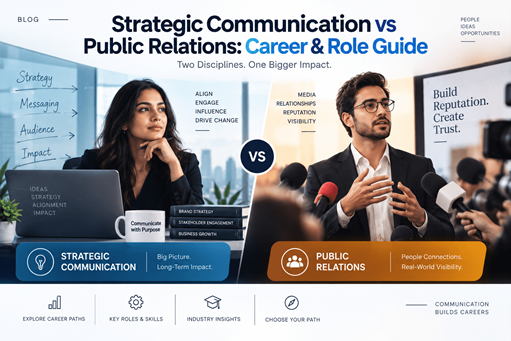
Strategic Communication vs Public Relations: Key Differences
Download Brochure
Home Blog Details

Strategic Communication vs Public Relations: Key Differences

Strategic Communication vs Public Relations: Key Differences

Strategic Communication vs Public Relations: Key Differences

Date: 12-Sep-2026 Author: JGU Online Categories: Career

Strategic Communication vs Public Relations: Roles, Skills, and Career Differences

If you are exploring a career in media, branding or organisational messaging, you have probably hit the same confusion as everyone else. Strategic communication vs public relations are they the same thing? Add corporate communication to the mix and the picture gets blurrier still. 

The three overlap heavily, share job titles and often sit inside the same department. Yet they are not interchangeable. 

Each has its own scope, its own success metrics and its own career path. This guide explains what strategic communication is, how corporate communication compares with PR, and which specialisation currently offers the strongest scope in India.

Key Takeaways
  • Strategic communication is the umbrella discipline: every message is planned to achieve a defined organisational outcome.
  • Corporate communication is organisation-centred and manages internal plus external identity, from employee comms to investor relations.
  • Public relations are relationship-centred and focuses on reputation, media and public perception.
  • Marketing communication persuades people to buy; PR earns credibility through third-party endorsement.
  • All three fall under communication management, which is the practice of planning, executing and measuring communication.
  • In India, strategic communication has the widest scope because it combines data, digital media and reputation skills in one profile.

What Is Strategic Communication?
Strategic communication is the purposeful use of communication to help an organisation achieve a defined goal. Every message, channel and audience choice is planned backwards from the outcome you want a policy change, a brand shift, a behaviour changes rather than produced first and justified later.

In practice, a strategic communicator starts with research: who the audience is, what they already believe, and what would move them. Only then do the campaign, the channels and the creative work follow. Measurement closes the loop.

Because it sits above the individual functions, strategic communication draws on public relations, advertising, corporate messaging, advocacy and data analytics at once. That breadth is exactly why it has become a standalone postgraduate specialisation for example, the Online M.Sc. in Strategic Communication offered by the Jindal School of Journalism and Communication.

What Is Corporate Communication?
Corporate communication manages how an organisation presents itself to everyone connected to it. It is the discipline that keeps the internal story and the external story consistent, so employees, investors, regulators and customers hear the same message.

Its work typically covers internal and employee communication, investor and financial communication, CSR and sustainability reporting, brand identity guidelines, leadership positioning, and crisis communication when something goes wrong.

The distinguishing feature is that corporate communication is organisation centred. Its job is to protect and express the company’s identity, whereas strategic communication asks a broader question about what outcome the organisation is chasing.

What Are Public Relations?
Public relations are the practice of building and maintaining mutually beneficial relationships between an organisation and its publics. PR professionals earn attention rather than buy it, which is why credibility is their core currency.

Day-to-day PR work includes media relations and press outreach, spokesperson training, event and launch publicity, influencer and community engagement, crisis response, and reputation monitoring.

PR is narrower than the other two disciplines, but it is also the oldest and most established, with the clearest entry-level career ladder in India.

Strategic Communication vs Public Relations: A Side-by-Side Comparison
The quickest way to understand the difference is to compare them on the same parameters.

Parameter

Strategic Communication

Corporate Communication

Public Relations

Core focus

Aligning every message with long-term organisational goals

Managing an organisation’s internal and external identity

Building and protecting relationships with the public

Scope

Broadest includes PR, branding, advocacy, internal comms

Organisation-wide, but company-centred

Narrower reputation, media and stakeholder relations

Key question

“What outcome do we want, and how does messaging get us there?”

“What does our organisation stand for, inside and outside?”

“What do our publics think of us, and why?”

Typical activities

Campaign strategy, audience research, message architecture, data analysis

Employee comms, CSR reporting, investor relations, brand identity

Media relations, press releases, crisis response, influencer outreach

Success metric

Behaviour and outcome change against stated objectives

Stakeholder trust, employee alignment, brand consistency

Earned coverage, share of voice, sentiment

Common job titles

Communication Strategist, Digital Strategist, Brand Consultant

Corporate Communication Officer, Internal Comms Manager

PR Manager, Media Relations Lead, Account Executive


Is Corporate Communication the Same as Public Relations?
No. They overlap but are not identical. Corporate communication looks inward and outward from the organisation and owns its identity, culture and stakeholder messaging. Public relations look outward at specific publics and owns reputation, media coverage and perception. In many Indian companies one team handles both, which is where the confusion begins.

A simple test: if the work involves an employee town hall, an annual report or an investor update, it is corporate communication. If it involves a journalist, a press note or a trending controversy, it is PR.

Difference Between PR and Marketing Communication
Marketing communication exists to sell. It uses paid, owned and controlled channels advertising, performance marketing, promotions and is measured in leads, conversions and revenue.

Public relations exist to build trust. It uses earned channels and third-party voices, and is measured in coverage quality, sentiment and share of voice. Marketing tells you the product is good; PR gets someone else to say it. Strategic communication decides when each approach should be used.

Types of Organisational Communication
Understanding the types of organisational communication makes the three disciplines easier to place.

  • Internal communication: messaging that flows between leadership, managers and employees - usually owned by corporate communication.
  • External communication: messaging directed at media, customers, regulators and the public - largely PR territory.
  • Formal communication: structured channels such as reports, policy circulars, press releases and investor filings.
  • Informal communication: peer conversations and workplace culture, which shape how formal messages are actually received.
  • Crisis communication: rapid, coordinated messaging during disruption-a shared responsibility across all three functions.   


Communication Management Explained

Communication management is the systematic planning, execution, monitoring and revision of all communication within and outside an organisation. Think of it as the operating system: strategic communication sets the direction, corporate communication and PR run as applications, and measurement feeds results back into the next cycle.

A good communication manager can move between all three. That is why postgraduate programmes now teach research methods, media ethics, brand building and analytics together rather than in silos. You can compare how different schools approach this across the full range of JGU Online programmes.

Which Communication Specialisation Has the Best Scope in India?

India’s communication industry has expanded sharply with digital media, regional-language content and the growth of ESG and reputation reporting. Demand now sits across three broad buckets.

  • Public relations offer the widest volume of entry-level roles, especially in agencies across Mumbai, Delhi NCR and Bengaluru.
  • Corporate communication offers stability and strong in-house progression, particularly in listed companies, banking and technology.
  • Strategic communication offers the fastest upward mobility, because employers increasingly want people who can read data, plan campaigns and manage reputation in one role.

If you want the broadest option, strategic communication is the safer long-term bet it keeps PR, corporate communication and brand roles open to you. Those drawn specifically to politics, elections and public opinion may prefer a focused route such as the M.A. in Political Communication, while more career guides are available on the JGU Online blog.

Common Misconceptions
  • “PR is just press releases.” Modern PR involves audience research, digital listening and crisis management far more than writing releases.
  • “Strategic communication is only for senior professionals.” Graduates enter the field directly; the strategic mindset is taught, not simply acquired with age.
  • “Corporate communication is only for large companies.” Start-ups and non-profits need identity and stakeholder management just as much.
  • “The three are interchangeable.” They share tools, but their goals, metrics and reporting lines differ.

Who Should Consider an Online M.Sc. in Strategic Communication?
This route suits graduates from any discipline who want a communication career, and working professionals in marketing, journalism or client servicing who want to move into strategy. An online masters in strategic communication in India also works well for anyone who cannot pause a job to relocate for a campus programme.

Eligibility
  • A bachelor’s degree in any discipline with a minimum of 50% marks, or relevant work experience.
  • Government-issued ID proof (passport for international applicants).
Selection Criteria
  • Bachelor’s degree from any recognised university.
Career Outcomes
What you will gain from completing the programme:
  • Master strategic communication: deliver impactful messages across corporate, media and public sectors.
  • Enhanced problem-solving: develop ethical, creative solutions to real-world communication challenges.
  • Industry preparedness: be job-ready for PR, branding, corporate communications and more.
  • Creative and ethical communication: craft responsible, engaging content in a globalised world.

Frequently Asked Questions

1. What is the difference between strategic communication and PR?
Strategic communication is the broader discipline that plans all messaging around a defined organisational outcome. Public relations are one function within it, focused specifically on reputation and relationships with media and the public. Every PR campaign can be strategic, but strategic communication also covers branding, internal comms and advocacy.

2. Is corporate communication the same as public relations?
No. Corporate communication manages an organisation’s identity across internal and external audiences, including employees and investors. Public relations concentrate on external perception and media relationships. The two teams frequently sit together and share people, but their objectives and metrics are different.

3. Which communication specialisation has the best scope in India?
Public relations have the highest volume of entry-level openings, corporate communication offers in-house stability, and strategic communication currently offers the widest long-term scope because it combines data, digital and reputation skills that Indian employers are actively hiring for.

4. Can I study strategic communication online while working?
Yes. Online master’s programmes are designed for working professionals, with live interactive classes plus recorded sessions. The one-year format at JGU Online lets you build strategy skills without stepping away from your current role.

5. Do I need a media or journalism background to apply?
No. A bachelor’s degree in any discipline is acceptable. Learners from engineering, commerce, law and the humanities regularly move into communication roles, and coursework in research, ethics and storytelling brings everyone to a shared baseline.

Start Your Communication Career with JGU Online
The distinction between strategic communication, corporate communication and public relations matters most when you are choosing where to specialise. If you want a qualification that keeps all three doors open, the one-year Online M.Sc. in Strategic Communication from the Jindal School of Journalism and Communication combines strategy, storytelling, brand building and public relations in a single, industry-facing curriculum.

Explore the JGU Online strategic communication curriculum, faculty and admission timelines on the JGU Online website, or apply for the upcoming batch to take the next step in your communication career.