


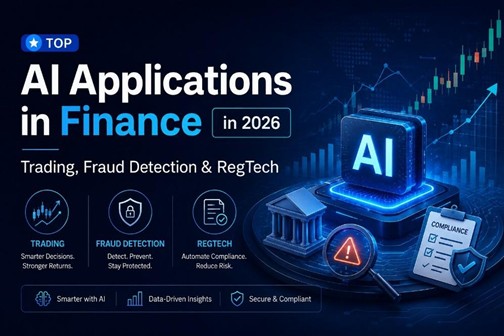
Top AI Applications in Finance in 2026: Trading, Fraud Detection & RegTech
Finance has always run on data. What changed is the speed. The top AI applications in finance now sit inside the everyday machinery of banks, asset managers and fintech firms approving loans, flagging suspicious payments, executing trades and filing compliance reports.
For students, this matters for one reason: employers no longer want people who understand only markets or only code. They want both.
This guide covers where artificial intelligence in financial services has the clearest impact in 2026, and the study routes that lead there.
Key Takeaways
- AI in finance is operational, not experimental. It already sits inside credit decisions, payment rails and trade execution.
- Five areas dominate. Algorithmic trading, credit risk, fraud detection, RegTech and personalised banking.
- Hybrid skills win. Python and machine learning matter only alongside genuine financial reasoning.
- Careers span both worlds. Roles span fintech, investment banking, risk analysis and AI-driven consulting.
- Structured study helps. JGU Online's B.Sc. and M.Sc. in Artificial Intelligence and Finance sit on this overlap.
What Is AI in Finance?
AI in finance is the use of machine learning, natural language processing and predictive modelling to make financial decisions faster and more consistently than manual analysis allows. Common AI use cases in finance include algorithmic trading, credit scoring, fraud detection, regulatory reporting and personalised customer service.
How is AI used in algorithmic trading? Machine learning models scan price history, order-book depth, macro releases and news sentiment to identify patterns, then execute orders automatically within pre-set risk limits. Natural language processing adds unstructured inputs such as earnings-call transcripts and filings.
2. Credit Risk Assessment
How does AI improve credit risk assessment?
Machine learning handles hundreds of variables and non-linear relationships
that traditional scorecards cannot, and can incorporate alternative data such
as cash-flow patterns and transaction history. This produces sharper risk
ranking and extends credit access to applicants with thin files.
3. Fraud Detection
How does AI detect financial fraud? Models build a behavioural baseline for each customer, then score every transaction in milliseconds against that baseline. Anomaly detection catches unfamiliar patterns, while graph analytics maps relationships between accounts to expose organised fraud rings and money-mule networks.
4. RegTech and Regulatory Compliance
What is the role of AI in RegTech and
regulatory compliance? AI reads and classifies regulatory text, maps new
obligations to internal controls, and automates KYC verification, transaction
monitoring and reporting. This reduces manual review effort and creates a
consistent, auditable trail of compliance decisions.
- Benefits of AI in Banking and Finance
- Speed: credit and fraud decisions in seconds rather than days.
- Scale: transaction volumes no manual team could review.
- Consistency: identical logic applied to every case.
- Access: alternative data helps extend formal credit to underserved borrowers.
- Cost efficiency: automated verification, reconciliation and reporting.
Common Misconceptions
AI is redistributing tasks rather than replacing jobs, reconciliation shrinks while model validation and risk oversight grow. Nor do you need to be an engineer: the most valuable people are translators, fluent enough in modelling to challenge a data scientist and fluent enough in finance to spot nonsense. And outputs are not objective models that inherit the biases of their training data.
Skills You Need to Work in AI and Finance
- Programming and data handling, typically Python, with tools such as Tableau.
- Statistics and machine learning, including validation and spotting noise.
- Core finance: corporate finance, investment analysis, portfolio management and risk.
Where to Study This: JGU Online Programme Structure
- Financial Analysis and Decision-Making - a foundation in corporate finance, investment analysis and risk management.
- Data Analytics with Python and Tableau - coding, visualisation and analytics applied to complex financial data.
- AI and Machine Learning Applications - neural networks, deep learning and AI-driven solutions for financial markets.
- FinTech and Digital Innovation - blockchain, digital currencies and the technologies reshaping banking.
- Trading and Market Tools Expertise - practical exposure to Bloomberg Terminals, trading labs and real-time simulations
Students also study financial markets and portfolio management and can choose electives to specialise further in finance or AI.
Online M.Sc. in Artificial Intelligence and Finance
The postgraduate route is for learners applying AI, data science and financial analytics directly to fintech, risk management and algorithmic trading the same domains covered above. Review the programme page for current curriculum and admission details.
- Applicants who have completed Class 12 (or equivalent) with 50% marks.
- Mathematics must have been studied at Class XII level.
- Government-issued ID proof (Aadhaar Card / Passport) for international learners
Selection is based on a comprehensive review of the applicant's profile, including academic performance, Statement of Purpose (SOP) and academic transcripts. Applications go through the university's admissions system, and further steps are communicated once an application is received.