


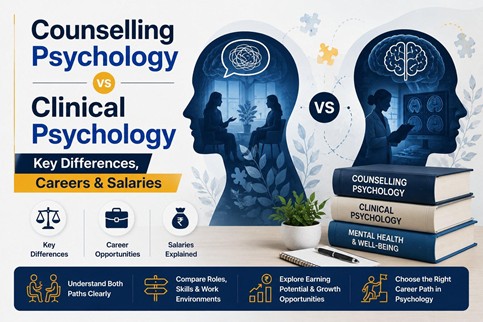
If you are drawn to mental health as a career, the counselling psychology vs clinical psychology question is usually the first fork in the road. Both fields help people feel better. Both involve deep listening, assessment and structured therapy. Yet they differ sharply in training length, licensing, work settings and earnings. In India, that difference matters even more, because only one of the two paths is regulated by a statutory council. This guide breaks down what separates a counsellor from a clinical psychologist, what each route demands, what you can realistically earn, and how an undergraduate psychology degree opens the door to either one.
Key Takeaways
- Counselling psychology focuses on everyday distress, adjustment and personal growth; clinical psychology focuses on diagnosis and treatment of mental disorders.
- In India, only clinical psychologists require registration with the Rehabilitation Council of India (RCI) to practise under that title.The RCI is phasing out the M.Phil. in Clinical Psychology and replacing it with a two-year RCI-regulated M.A. in Clinical Psychology.
- Clinical psychologists generally earn more than counselling psychologists in India, largely because of longer, licensed training and hospital-based roles.
- Both careers begin with the same foundation: a recognised bachelor's degree in psychology (Blended).
- An Online B.Sc. in Psychology (Blended) lets you build that base flexibly before committing to a specialisation at the master's level.
What Is Counselling Psychology?
In short: Counselling psychology is the applied branch of psychology that helps people manage life stress, relationships, career confusion, grief and emotional adjustment. Counselling psychologists work with largely healthy inpiduals facing difficult circumstances, using talk-based therapy to build coping skills, resilience and self-understanding.
Think of a college student struggling with exam anxiety, a couple navigating conflict, or an employee burning out at work. These are not psychiatric emergencies. They are ordinary human difficulties that respond well to structured conversation, psychoeducation and skill-building.
Counselling psychologists typically work in schools and universities, corporate wellness teams, NGOs, community centres, de-addiction programmes and online therapy platforms. Many also run independent private practices.
What Is Clinical Psychology?
In short: Clinical psychology is the branch concerned with assessing, diagnosing and treating mental disorders and severe psychological distress. Clinical psychologists are trained in psychological testing, diagnostic classification and evidence-based interventions, and usually work alongside psychiatrists in hospitals and mental health institutions.
A clinical psychologist may administer an IQ or neuropsychological assessment, prepare a diagnostic report for conditions such as schizophrenia, bipolar disorder or OCD, and deliver structured treatment like cognitive behavioural therapy as part of a medical team.
Importantly, clinical psychologists do not prescribe medication in India. That remains the domain of psychiatrists, who hold an MBBS followed by an MD in psychiatry.
Counselling Psychology vs Clinical Psychology: Key Differences
The table below summarises how the two fields compare in the Indian context.
Parameter |
Counselling Psychology | Clinical Psychology |
|---|---|---|
Primary focus |
Everyday stress, adjustment, growth |
Diagnosis and treatment of mental disorders |
Typical clients |
Largely well-functioning inpiduals |
Inpiduals with clinical diagnoses |
Core skills |
Talk therapy, guidance, psychoeducation |
Psychological testing, diagnosis, intervention |
Regulation in India |
No separate statutory licence at present |
RCI registration required (CRR) |
Typical qualification |
M.A. / M.Sc. in Counselling Psychology |
RCI-approved M.A. in Clinical Psychology |
Common settings |
Schools, corporates, NGOs, private practice |
Hospitals, psychiatric institutes, rehab centres |
Severity handled |
Mild to moderate distress |
Moderate to severe psychopathology |
What Is the Difference Between a Counsellor and a Clinical Psychologist?
Quick answer: A counsellor supports people through life challenges using guidance and talk-based methods, and may hold a diploma or master's in counselling. A clinical psychologist is a licensed professional trained to assess, diagnose and treat mental illness, and must be registered with the RCI to practise under that title in India.
The confusion is understandable, because the three roles sit on a spectrum rather than in separate boxes. Here is how they usually stack up:
- Counsellor: often a diploma or postgraduate qualification in counselling. Works with stress, relationships, career and study concerns. Cannot diagnose.
- Counselling psychologist: holds a master's degree in psychology or counselling psychology. Offers structured therapy for mild to moderate concerns. Does not issue clinical diagnoses.
- linical psychologist: completes an RCI-approved professional programme and clinical internship. Can assess, diagnose and treat mental disorders, and is legally recognised as a mental health professional.
Do I Need an RCI Licence to Practise Counselling Psychology?
Quick answer: No. As of now, the Rehabilitation Council of India regulates clinical psychology, not counselling psychology. You do not need RCI registration to work as a counsellor or counselling psychologist. You do need it to legally call yourself and practise as a clinical psychologist.
The RCI is a statutory body under the Ministry of Social Justice and Empowerment. It approves training programmes, prescribes curriculum and supervised clinical hours, and maintains the Central Rehabilitation Register (CRR) of qualified professionals.
There is an important update every aspiring clinical psychologist should know. The M.Phil. in Clinical Psychology, long the standard licensure route, is being phased out in line with NEP 2020 reforms. It is being replaced by a two-year RCI-regulated M.A. in Clinical Psychology, with the transition taking effect from the 2026-27 academic session. Because approval status varies by institution and changes over time, always verify a programme directly on the official RCI website before you apply.
For counselling roles, credibility comes from a different place: a recognised master's degree, supervised practice hours, training in specific modalities such as CBT or REBT, and professional body memberships.
Types of Psychologists in India
Psychology is not one career. It is a family of them. Knowing the full map helps you choose deliberately rather than by default.
- Clinical psychologist: assesses and treats mental disorders in hospitals and clinics.
- Counselling psychologist: supports emotional wellbeing, adjustment and personal growth.
- Educational or school psychologist: works with learning difficulties, student wellbeing and academic guidance.
- Industrial-organisational psychologist: applies psychology to hiring, leadership, culture and productivity.
- Neuropsychologist: studies the link between brain function and behaviour, often after injury or illness.
- Forensic psychologist: works at the intersection of psychology and the legal system.
- Sports psychologist: builds mental performance and recovery for athletes.
- Health psychologist: focuses on behaviour change, chronic illness and public health.
How to Become a Counselling Psychologist in India
- Complete Class 12 in any stream. Psychology accepts arts, science and commerce backgrounds.
- Earn a bachelor's degree in psychology, such as a B.A. or B.Sc. in Psychology (Blended), from a recognised university.
- Pursue a master's degree in Psychology or Counselling Psychology with a counselling specialisation.
- Build supervised practice hours through internships, practicums and placements at wellness centres, schools or NGOs.
- Add therapy-specific certifications such as CBT, REBT or trauma-informed practice to strengthen your practice.
- Consider a Ph.D. later if you want to move into research, academia or senior clinical supervision.
How to Become a Clinical Psychologist in India
The clinical route follows the same first two steps, then perges. After a bachelor's and a master's in psychology, you must complete an RCI-approved professional programme in clinical psychology, which includes intensive supervised clinical training. You then register with the Central Rehabilitation Register to practise legally. Seats in RCI-approved programmes are limited and entrance competition is high, so plan early.
Counselling Psychologist Salary India vs Clinical Psychologist Salary
Which pays more? Clinical psychology generally pays more in India. Salary aggregators place the average counselling psychologist around ₹3.4 lakh per year and the average clinical psychologist closer to ₹4.9 lakh per year. The gap widens with experience, licensure and private practice.
Stage |
Counselling Psychologist | Clinical Psychologist |
|---|---|---|
Entry level (0-2 yrs) |
₹2.5 - ₹4 LPA |
₹3 - ₹5 LPA |
Mid level (3-7 yrs) |
₹4 - ₹8 LPA |
₹6 - ₹12 LPA |
Senior / specialised |
₹10 - ₹18 LPA |
₹15 - ₹25 LPA |
Private practice |
₹800 - ₹2,500 per session |
₹1,500 - ₹4,000 per session |
These are indicative ranges compiled from salary platforms such as PayScale, Glassdoor and public job listings, and they vary widely. Treat them as a direction of travel, not a promise.
Clinical Psychologist Scope in India
India's mental health workforce is severely stretched relative to demand, and the shortage of licensed clinical psychologists is well documented. That imbalance creates real, durable career security for those who complete the licensure pathway.
- Government and private hospitals, and psychiatric institutions
- Rehabilitation and de-addiction centres
- Child guidance clinics and special education settings
- Research and teaching roles in universities
- Court, prison and forensic assessment work
- Digital mental health platforms and telehealth services
Counselling psychology, meanwhile, is expanding fastest in workplaces and education. Corporate Employee Assistance Programmes, school wellbeing cells and online therapy platforms have created a category of roles that barely existed a decade ago.
Common Misconceptions to Clear Up
- "Clinical psychologists prescribe medicine." They do not. Prescribing is restricted to psychiatrists, who are medical doctors.
- "Counselling is the easier option." It is a different skill set, not a lesser one. Building a sustainable practice takes years.
- "A master's degree alone makes you a clinical psychologist." It does not. RCI-approved professional training and registration are mandatory.
- "You must study science in Class 12." Psychology programmes in India accept students from all streams.
Which Path Should You Choose?
Choose counselling psychology if you are energised by open-ended conversation, prefer flexible settings such as schools or corporates, and want to start practising sooner after your master's.
Choose clinical psychology if you are drawn to assessment, diagnosis and complex cases, are comfortable in medical environments, and are willing to commit to a longer, more competitive licensure path.
Here is the reassuring part: you do not have to decide today. Both roads start at exactly the same place, with a strong undergraduate grounding in psychological theory, research methods and practical exposure.
Build Your Foundation with an Online B.Sc. in Psychology
Whichever specialisation you eventually pick, your bachelor's degree decides how prepared you are for master's-level entrance exams and internships. The Online B.Sc. in Psychology (Blended) from O.P. Jindal Global University is designed for exactly this stage, combining academic rigour with the flexibility to study alongside work or other commitments.
Why Choose JGU Online B.Sc. in Psychology (Blended)?
- Learn from Global Experts: Faculties with international experience guide your journey in psychology.
- Hands-On Experience: Internships and practicums let you apply learning in real-world settings.
- Customise Your Path: Multidisciplinary electives and flexible programme structure to suit your goals.
- Flexible Exit Options: Offers multiple exit options with Certificate, Diploma, and Degree awards in line with NEP 2020.
- Optional On-Campus Immersion: Gain in-person exposure for practical insights.
Eligibility
- Applicants who have completed Class 12 (or equivalent) with 50% marks.
- Govt. Issued ID Proof (Aadhar Card / Passport) for International Learners.
Selection Criteria
Applicants who have completed Class 12 (or equivalent) with less than 50% marks will need to pass the online JSAT (Jindal Scholastic Aptitude Test) with a score of 50% or equivalent SAT/ACT/LNAT-UK, or a MOOC by JGU to secure admission.
Frequently Asked Questions
What is the difference between a counsellor and a clinical psychologist?
A counsellor helps people work through everyday emotional and situational difficulties using guidance and talk-based support. A clinical psychologist is trained and licensed to assess, diagnose and treat diagnosable mental disorders, and must be registered with the RCI to practise under that title in India.
Which pays more, counselling or clinical psychology in India?
Clinical psychology typically pays more. Averages hover near ₹4.9 lakh per year for clinical psychologists against roughly ₹3.4 lakh for counselling psychologists, reflecting longer licensed training. However, experienced counselling psychologists in private practice or corporate wellness can earn comparable or higher incomes.
Do I need an RCI licence to practise counselling psychology?No. The RCI currently regulates clinical psychology, not counselling psychology. You can practise as a counsellor or counselling psychologist with a recognised master's degree and supervised experience. RCI registration is mandatory only for practising as a clinical psychologist.
Can I become a clinical psychologist with an online B.Sc. in Psychology (Blended)?
Yes, provided the degree is from a recognised university and meets NEP 2020 norms. Your bachelor's degree qualifies you to apply for a master's, after which you would complete an RCI-approved professional programme in clinical psychology to become licensed.
Is psychology a good career choice in India in 2026?
Yes. Rising mental health awareness, workplace wellbeing programmes and digital therapy platforms have widened demand well beyond hospitals. India also has a significant shortage of trained mental health professionals, which supports long-term career stability across both specialisations.
Start Your Psychology Journey Today
Counselling and clinical psychology both begin with one decision: getting the fundamentals right. The Online B.Sc. in Psychology (Blended) from O.P. Jindal Global University gives you that foundation, with globally experienced faculty, real internships, multidisciplinary electives and NEP 2020-aligned exit options, all in a format that fits your life.
Explore the JGU Online B.Sc. in Psychology (Blended) programme and take the first step towards a career in mental health.