


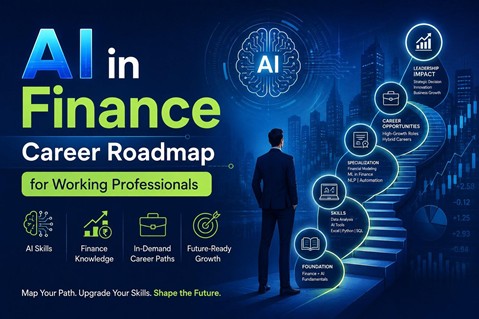
AI in Finance Career Roadmap: How Working Professionals Can Get Started
If you are a financial analyst, credit officer or risk associate wondering how to stay relevant, this AI in Finance career roadmap is written for you. You do not need to abandon finance and retrain as a software engineer.
The people banks, asset managers and fintechs are competing for are those who understand cash flows and can also work with data and models.
This guide sets out a realistic AI finance career path for working professionals: which skills to build, in what order, and which qualifications formalise the move.
- The roadmap runs in stages: AI literacy, technical fluency, applied modelling, then a formal qualification.
- AI is redistributing analyst work, not deleting it data gathering shrinks, judgement grows.
- Core skills: Python, SQL, statistics, machine learning fundamentals, visualisation and model governance.
- Domain knowledge is your advantage. A finance professional who learns AI competes better than an engineer who learns finance.
- A structured degree such as the Online M.Sc. in Artificial Intelligence and Finance shortens the path and signals credibility.
- Target roles: AI-Finance Specialist, risk modelling analyst, quantitative analyst, fintech analyst, AI consulting.
What Is the AI in Finance Career Roadmap?
An AI in Finance career roadmap is a staged plan that moves a finance professional from simply using AI tools to building, validating and governing AI models that inform financial decisions. It usually progresses through four stages: AI literacy, technical fluency in Python and data, applied financial modelling, and formal specialisation through a degree.
Is AI Replacing Financial Analysts or Changing Their Role?
AI is changing the role rather than replacing it. Tools now handle data extraction, first-draft reporting and pattern detection. What stays human is framing the right question, judging whether an output is credible, explaining it to a committee and owning the decision.
Consider a valuation model. An analyst who once spent three days on it now drafts one in an afternoon. The remaining value sits in challenging the growth assumption, spotting misleading comparables set and defending the number. That is a more senior job, not a smaller one which is why an AI career in financial services rewards analysts who move up the judgement curve.
- Python for finance. Pandas and NumPy for financial data the highest-return skill for an analyst.
- SQL. Pulling your own data instead of waiting on a data team changes how fast you can work.
- Statistics and probability. Regression, distributions and hypothesis testing without these, machine learning is guesswork in better packaging.
- Machine learning fundamentals. Classification for credit default, regression for forecasting, and an honest grasp of overfitting.
- Data visualisation. Tableau or Power BI an insight nobody understands changes nothing.
- Model risk and AI governance. Explainability, bias testing and documentation often what separates a specialist from an enthusiast.
- Generative AI literacy. Knowing where language models help with research and drafting, and where they must not touch a regulated calculation.
- FinTech product and analytics roles at payments, lending and wealth platforms.
- Risk management and risk analysis credit scoring, fraud detection, model validation.
- Investment banking and algorithmic trading quantitative analysis, signal research.
- AI-driven consulting advising institutions on where AI genuinely adds value.
Finance AI Certification Options: Two JGU Online Programmes
O.P. Jindal Global University offers two online degrees at the intersection of AI and finance. Which fits depends on where you start.
Online M.Sc. in Artificial Intelligence and Finance
The M.Sc. in Artificial Intelligence & Finance is designed for learners who want to apply AI, data science and financial analytics to areas such as fintech, risk management and algorithmic trading. For a working professional with a bachelor’s degree, this is the direct route it adds the technical layer on top of domain knowledge you already have.
Eligibility and Selection Criteria for M.Sc. in Artificial Intelligence & Finance
Eligibility:
- Undergraduate degree with at least 50% marks
- Candidates with less than 50% marks must:
- Appear for the JSAT examination, and
- Attend a mandatory interview
Admission decisions are based on a comprehensive review of the applicant’s profile, including academic performance, Statement of Purpose (SOP), and academic transcripts. Shortlisted candidates may also be invited for a personal interview to assess their motivation and program fit.
Online B.Sc. in Artificial Intelligence & Finance
The B.Sc. in Artificial Intelligence and Finance, offered by the Jindal School of Banking & Finance, is India’s only undergraduate programme combining finance, AI and a 12-month industry co-op, blending online flexibility with on-campus immersion.
Course structure and learning areas include:
- Financial Analysis and Decision-Making - corporate finance, investment analysis, risk management.
- Data Analytics with Python and Tableau - coding, visualisation and analytics for financial data.
- AI and Machine Learning Applications - neural networks, deep learning and AI-driven solutions for markets.
- FinTech and Digital Innovation - blockchain, digital currencies and technologies reshaping banking.
- Trading and Market Tools Expertise - Bloomberg Terminals, trading labs and real-time simulations.
The syllabus also covers financial markets, portfolio management and data science, with electives to build depth in either finance or AI.
- Applicants who have completed Class 12 (or equivalent) with 50% marks.
- Must have studied at least one of the following subjects:
- Mathematics
- Business Mathematics
- Statistics
- Business Studies
- Govt. Issued ID Proof (Aadhar Card / Passport) for International Learners.
Selection Criteria:
Admission to the programme is based on a multi-step evaluation process:
Submit the Application Form
- Complete and submit the online admission form.
FACTA Assessment
- Appear for FACTA (Finance Aptitude and Critical Thinking Assessment) conducted by the university.
Personal Interview
- Shortlisted candidates are invited for a personal interview.
Final Selection
- Admission is granted based on overall performance across the assessment and interview.
Career Outcomes
Graduates of the B.Sc. in Artificial Intelligence and Finance can pursue careers in fintech, investment banking, risk analysis and AI-driven consulting, developing both financial expertise and technological fluency. The M.Sc. in Artificial Intelligence & Finance is oriented towards fintech, risk management and algorithmic trading. The differentiator in both cases: neither a pure finance generalist nor a pure technologist.
- "I need to be good at maths first." You need comfort with statistics and willingness to practise. Most finance professionals already handle harder quantitative reasoning than they realise.
- "I am too late." Adoption across Indian financial services is still uneven. The shortage is of people who can apply machine learning to a credit or trading problem and defend the result.
- "A short course is enough." Short courses build skills but rarely change how employers categorise you. A degree does both.
FAQs
What is the AI career roadmap for finance professionals?
A four-stage progression: build AI literacy in your current role, develop technical fluency in Python and SQL, formalise it through a qualification such as an M.Sc. in AI and Finance, then own a model end to end.
How can a financial analyst become an AI finance specialist?
Automate part of a task you own, then learn Python and SQL by rebuilding a model you trust. Add a qualification combining AI with finance, then complete an applied project you can present internally.
Which AI skills are required for finance professionals?
Python, SQL, statistics, machine learning fundamentals, data visualisation with Tableau or Power BI, and an understanding of model risk and AI governance. Generative AI literacy is increasingly expected too.
Is AI replacing financial analysts?
No. AI automates data gathering and first-draft analysis while raising the value of judgement, model validation and communication. Analysts who learn to supervise and interpret models become more valuable.
What certifications are best for an AI career in finance?
For working professionals, a degree integrating both disciplines carries more weight than a standalone tool certificate. JGU Online’s M.Sc. and B.Sc. in Artificial Intelligence & Finance are both designed for this combination.