

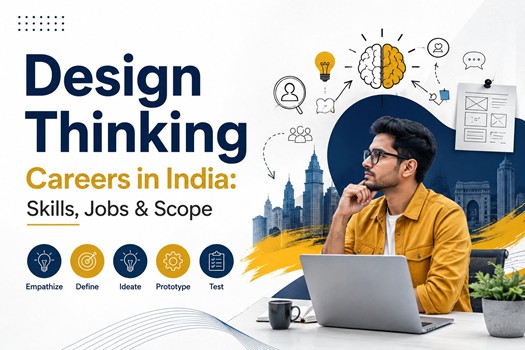
M.Sc. in Design Thinking, Innovation & Strategy Careers in India: Scope, Jobs & Opportunities
Introduction
Quick Answer: Is M.Sc. in Design Thinking, Innovation & Strategy a Good Career in India?
Key Takeaways
|
Question |
Direct Answer |
|
Is Design Thinking a career in India? |
Yes, it supports careers in UX, product, consulting,
innovation, CX, and strategy. |
|
What are the top Design Thinking jobs? |
UX designer, product designer, service designer, UX
researcher, innovation consultant, and product manager. |
|
What is the Design Thinking salary in India? |
Entry-level roles may start around ₹3–8 LPA; senior roles
can cross ₹20–35 LPA. |
|
Which industries hire Design Thinking talent? |
SaaS, IT, fintech, EdTech, healthcare, consulting, BFSI,
e-commerce, and startups. |
|
Is coding required for Design Thinking careers? |
No, but technology awareness and tool fluency help. |
|
Is Design Thinking useful for non-designers? |
Yes, it is useful for managers, founders, educators,
consultants, and product teams. |
Important Definitions
Design Thinking: Design Thinking is a human-centred problem-solving framework used to understand users, define problems, ideate, prototype, test, and improve solutions.
Design Thinking, Innovation & Strategy Career Roles in India
Design Thinking careers in India are expanding beyond traditional design roles. Today, organisations need professionals who can combine human-centred problem-solving, technology, business strategy, innovation, and customer understanding.
A Master’s in Design Thinking can prepare professionals for roles across product innovation, digital transformation, entrepreneurship, strategy, research, and leadership. The career opportunities are especially relevant in industries such as technology, fintech, healthcare, EdTech, consulting, SaaS, startups, and business transformation.
Top Career Opportunities After M.Sc. in Design Thinking, Innovation & Strategy Programme
|
Career Role |
What They Do |
Career Scope |
|
Business Strategist |
Uses design thinking principles to identify
business opportunities, develop customer-focused strategies, and create
innovative solutions aligned with organisational goals. |
Strategy consulting, business transformation,
innovation teams, startups |
|
AI-Driven Experience Designer |
Designs intelligent user experiences by combining
AI technologies, user research, automation, and human-centred design
principles. |
AI products, digital platforms, SaaS, fintech,
healthcare technology |
|
Design Researcher |
Studies user behaviour, customer needs,
motivations, and pain points to generate insights that guide product and
service decisions. |
UX research, product teams, innovation labs,
consulting |
|
Leadership Roles |
Leads innovation initiatives, manages
cross-functional teams, drives organisational change, and builds future-ready
strategies. |
Innovation leadership, product leadership,
digital transformation |
|
Entrepreneur / Startup Founder |
Applies design thinking to identify market
problems, validate ideas, build prototypes, and create customer-focused
businesses. |
Startups, entrepreneurship, venture building |
|
Design Strategist / Service Designer |
Creates strategies and improves end-to-end
customer experiences across products, services, processes, and touchpoints. |
Consulting, CX teams, healthcare, BFSI,
education, hospitality |
|
Digital Transformation Lead |
Helps organisations adopt new technologies,
redesign processes, and create digital-first experiences. |
Technology consulting, enterprises,
transformation projects |
|
Learning Experience Designer |
Designs engaging learning journeys by combining
pedagogy, technology, user insights, and innovation. |
EdTech, corporate learning, education platforms |
Design Thinking, Innovation & Strategy Career Paths Across Industries
The value of Design Thinking is that it applies across multiple industries. Professionals are not limited to design teams; they can work in roles that influence business growth, customer experience, innovation, and organisational change.
|
Industry |
Possible Career Opportunities |
|
Technology & SaaS |
AI-driven experience designer, product strategist,
digital transformation lead |
|
Fintech & BFSI |
Service designer, customer experience strategist,
innovation consultant |
|
Healthcare |
Design strategist, service designer, experience
transformation roles |
|
EdTech |
Learning experience designer, education innovation roles |
|
Consulting |
Innovation consultant, business strategist, design
researcher |
|
Startups |
Entrepreneur, product leader, business designer |
|
Enterprises |
Digital transformation lead, innovation manager,
leadership roles |
Why M.Sc. in Design Thinking, Innovation & Strategy Careers Are Growing in 2026
Companies today are not only looking for professionals who can create products; they need people who can identify the right problems and design meaningful solutions.
M.Sc. in Design Thinking, Innovation & Strategy Salary in India 2026
Design Thinking salary in India depends on role, city, portfolio, tools, company type, experience, communication, and ability to show business impact.
|
Career Level |
Typical Salary Range |
|
Fresher / Intern |
₹2.5-5 LPA |
|
Entry-Level Designer / Associate |
₹3-8 LPA |
|
2-5 Years Experience |
₹7-18 LPA |
|
Senior UX / Product Designer |
₹18-35 LPA |
|
Design Lead / Innovation Lead |
₹30-60 LPA+ |
|
Independent Consultant |
Project-based; income varies widely |
Industries Hiring Design Thinking Professionals in India
Design Thinking is valuable wherever businesses need to improve user experience, service quality, customer retention, digital adoption, or innovation speed
|
Industry |
Why It Hires Design Thinking Talent |
|
IT and SaaS |
To build better software, dashboards, and
enterprise platforms |
|
Fintech |
To simplify payments, lending, investing,
onboarding, and trust |
|
EdTech |
To improve student journeys, learning platforms,
and engagement |
|
Healthcare |
To improve patient journeys, health apps, and
hospital services |
|
BFSI |
To improve banking, insurance, wealth, and
customer support experiences |
|
E-commerce |
To improve conversion, search, checkout, and
retention |
|
Consulting |
To run innovation workshops and solve business
problems |
|
Startups |
To test ideas, improve product-market fit, and
prototype quickly |
|
Public sector |
To improve citizen services, accessibility, and
policy delivery |
|
Manufacturing |
To improve product usability, service systems,
and customer support |
Skills That Support These Career Paths
Successful Design Thinking professionals combine creativity with analytical thinking, technology awareness, and business understanding.
- User research and behavioural analysis
- Customer journey mapping
- Design research methodologies
- Prototyping and experimentation
- Business model innovation
- Product strategy
- Digital transformation frameworks
- AI tools and emerging technologies
- Stakeholder management
- Innovation leadership
Industry Statistics and Future Outlook
Design Thinking careers are supported by three larger trends: digital transformation, AI adoption, and the rising importance of human skills. Companies are using AI to automate repetitive tasks, but they still need people who can understand users, ask the right questions, make ethical decisions, and design meaningful experiences.
Expert Insights
Common Mistakes Beginners Make
The biggest mistake is assuming Design Thinking means only UI design or graphic design. Design Thinking is broader. It includes research, strategy, product thinking, business understanding, testing, and problem-solving.
Best Practices for Getting Hired
Build a portfolio with 3-4 strong case studies. Each case study should answer: What was the problem? Who was the user? What research did you do? What insights did you find? What solution did you create? How did you test it? What was the impact?
Real-World Examples
A fintech company may hire a product designer to simplify loan onboarding and reduce drop-offs. A hospital may hire a service designer to improve patient appointment and discharge journeys. An EdTech company may hire a learning experience designer to improve student engagement. A consulting firm may hire an innovation associate to run workshops for clients. A startup may hire a UX researcher to test product-market fit before building a full app.
Frequently Asked Questions
Conclusion