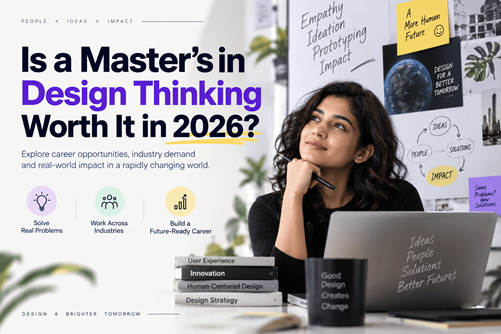
M.Sc. in Design Thinking, Innovation & Strategy: Is It Worth It in 2026?
An M.Sc. in Design Thinking, Innovation & Strategy is worth it in 2026 for professionals who want to move into innovation, product strategy, UX leadership, service design, customer experience, consulting, entrepreneurship, or business transformation roles. It is especially useful for product managers, team leads, designers, startup founders, educators, marketers, and business managers who need structured problem-solving skills.
M.Sc. in Design Thinking, Innovation & Strategy is a human-centred innovation approach. It helps professionals understand users, define the right problem, generate ideas, build prototypes, test solutions, and improve products or services before making large investments.
In a market shaped by AI, digital transformation, SaaS, fintech, EdTech, healthcare innovation, and customer experience competition, this skill has become more valuable across industries.
A design thinking degree is not only for designers. It is increasingly relevant for product leaders, managers, business strategists, founders, and professionals who work with cross-functional teams. Programmes such as JGU Online’s M.Sc. in Design Thinking, Innovation & Strategy are designed for learners who want a structured postgraduate pathway into innovation-led careers.
Quick Answer: Is an M.Sc. in Design Thinking, Innovation & Strategy Worth It in 2026?
Yes, an M.Sc. in Design Thinking, Innovation & Strategy is worth it if your career goal involves solving complex business, product, service, or customer problems. It is most valuable when it helps you build a portfolio, improve decision-making, lead innovation projects, understand users, and connect design with business outcomes.
However, the degree is not automatically valuable only because of the title. Its ROI depends on curriculum quality, faculty, flexibility, project work, portfolio development, industry relevance, and how actively the learner applies Design Thinking to real problems.
For product managers, the value is especially strong because Design Thinking improves product discovery, user research, feature prioritisation, customer journey mapping, prototyping, experimentation, and stakeholder alignment.
Key Takeaways
|
Question
|
Direct Answer
|
|
Is an M.Sc. in Design Thinking, Innovation &
Strategy worth it?
|
Yes, if you want careers in product, UX,
innovation, service design, CX, or strategy.
|
|
Who should pursue it?
|
Product managers, designers, founders,
consultants, educators, marketers, and business leaders.
|
|
Is it useful for product managers?
|
Yes. It improves user research, product
discovery, prioritisation, and customer-centric decision-making.
|
|
What are the career benefits?
|
Better innovation skills, portfolio development,
leadership readiness, and cross-functional problem-solving.
|
|
What is the salary after an M.Sc. in Design
Thinking, Innovation & Strategy?
|
Salary varies by role; UX/product roles may range
from ₹3–8 LPA entry-level to ₹20–35 LPA+ at senior levels.
|
|
Is it better than a short course?
|
M.Sc. is better for structured depth; a short
course is better for quick upskilling.
|
Important Definitions
M.Sc. in Design Thinking, Innovation & Strategy: This is a postgraduate programme focused on human-centred innovation, problem-solving, product strategy, prototyping, user research, and business transformation.
M.Sc. in Design Thinking, Innovation & Strategy Postgraduate Programme: This postgraduate programme teaches learners how to solve complex problems using empathy, ideation, experimentation, and strategy.
Product Discovery: Product discovery is the process of understanding customer problems, testing ideas, and deciding what product features should be built.
Service Design: Service design improves complete service journeys across people, processes, tools, systems, and customer touchpoints.
UX Strategy: UX strategy connects user experience decisions with business goals, product growth, usability, and customer value.
Innovation Strategy: Innovation strategy helps organisations identify future opportunities, create new solutions, and test ideas before scaling.
Who Should Pursue M.Sc. in Design Thinking, Innovation & Strategy?
|
Learner Type
|
Why It Helps
|
|
Product Managers
|
Improves discovery, prioritisation, user
research, and roadmap thinking
|
|
UX / UI Designers
|
Builds strategic design, research, and business
problem-solving capability
|
|
Business Managers
|
Helps solve customer, process, and innovation
challenges
|
|
Startup Founders
|
Supports idea validation, prototyping, MVP
planning, and customer testing
|
|
Consultants
|
Helps structure workshops, research, innovation
sprints, and transformation projects
|
|
Educators
|
Supports learning design, EdTech innovation, and
student experience improvement
|
|
Marketers
|
Improves customer journey mapping, brand
experience, and campaign strategy
|
|
Family Business Leaders
|
Helps modernise services, customer experience,
and new business models
|
The programme is especially useful for professionals who are no longer satisfied with execution-only roles and want to move into strategy, leadership, or innovation-led decision-making.
M.Sc. in Design Thinking, Innovation & Strategy Course for Product Managers
M.Sc. in Design Thinking, Innovation & Strategy course for product managers is valuable because product managers must decide what to build, why to build it, and how it will create user and business value. Design Thinking helps product managers avoid building features based only on assumptions.
|
Product Manager Challenge
|
How M.Sc. in Design Thinking, Innovation &
Strategy Helps
|
|
Unclear user needs
|
Uses interviews, observation, and research
|
|
Feature overload
|
Prioritises problems, not just requests
|
|
Weak product adoption
|
Improves usability and customer relevance
|
|
Poor stakeholder alignment
|
Uses journey maps, prototypes, and visual
thinking
|
|
High development waste
|
Tests ideas before full build
|
|
Low customer retention
|
Improves experience and value delivery
|
|
AI product uncertainty
|
Helps design responsible, user-centred AI
workflows
|
For product managers, Design Thinking is not a soft skill. It is a decision system that improves product-market fit, roadmap quality, experimentation, and stakeholder communication.
Career Opportunities After M.Sc. in Design Thinking, Innovation & Strategy
Career opportunities after M.Sc. in Design Thinking, Innovation & Strategy include roles in product, UX, service design, innovation, consulting, education, healthcare, fintech, startups, and business strategy.
|
Career Role
|
What You Do
|
|
Product Manager
|
Defines product vision, roadmap, features, and
user value
|
|
UX Researcher
|
Studies user needs, behaviours, pain points, and
usability
|
|
Product Designer
|
Designs digital products, journeys, flows, and
prototypes
|
|
Service Designer
|
Improves full customer journeys across systems
and touchpoints
|
|
Innovation Consultant
|
Helps organisations test new ideas and solve
business problems
|
|
Design Strategist
|
Connects design, brand, customer insight, and
business growth
|
|
Customer Experience Manager
|
Improves satisfaction, retention, and service
quality
|
|
Business Designer
|
Builds business models, value propositions, and
go-to-market ideas
|
|
Learning Experience Designer
|
Designs better learning journeys for EdTech and
education
|
|
Startup Founder
|
Uses Design Thinking and Innovation to validate
ideas and build customer-led ventures
|
The strongest career outcomes usually come when learners combine an M.Sc. in Design Thinking, Innovation & Strategy degree with a portfolio, internships, live projects, tools, communication skills, and measurable business impact.
Salary After M.Sc. in Design Thinking, Innovation & Strategy in India
Salary after M.Sc. in Design Thinking, Innovation & Strategy in India depends on prior experience, role, city, industry, portfolio, and company type. The degree can help with career mobility, but salary growth comes from applying the skill to real business and product outcomes.
|
Career Level
|
Typical Salary Range
|
|
Entry-level UX / Innovation Roles
|
₹3-8 LPA
|
|
Mid-level Product / UX / CX Roles
|
₹8-18 LPA
|
|
Senior Product Designer / Strategist
|
₹18-35 LPA
|
|
Product Lead / Innovation Lead
|
₹30-60 LPA+
|
|
Independent Consultant
|
Project-based; income varies widely
|
Product designers and UX professionals often have clearer salary benchmarks. M.Sc. in Design Thinking, Innovation & Strategy roles may appear under titles such as innovation consultant, design strategist, service designer, product manager, customer experience manager, or business designer.
M.Sc. in Design Thinking, Innovation & Strategy vs Short Course
|
Factor
|
M.Sc. in Design Thinking, Innovation &
Strategy
|
Short Course
|
|
Depth
|
High
|
Basic to moderate
|
|
Duration
|
Longer
|
Shorter
|
|
Best for
|
Career shift, leadership, postgraduate credential
|
Quick upskilling
|
|
Portfolio development
|
Stronger if project-based
|
Limited unless self-driven
|
|
Academic value
|
Higher
|
Lower
|
|
Flexibility
|
Depends on programme
|
Usually flexible
|
|
Best learner
|
Serious career builder
|
Working professional testing interest
|
A short course is useful for learning basics. M.Sc. degree is better for learners who want structured depth, academic credibility, research exposure, and long-term career positioning.
Best M.Sc. in Design Thinking, Innovation & Strategy in India: What to Check
The best M.Sc. in Design Thinking, Innovation & Strategy in India should offer more than theory. It should help learners build practical, portfolio-ready work.
|
What to Check
|
Why It Matters
|
|
Curriculum
|
Should include Design Thinking, Innovation, product
strategy, research, and business
|
|
Faculty
|
Should include academic and industry exposure
|
|
Projects
|
Helps convert theory into portfolio evidence
|
|
Flexibility
|
Important for working professionals
|
|
Tools
|
Figma, Miro, FigJam, AI tools, analytics,
prototyping platforms
|
|
Career relevance
|
Should connect with UX, product, service design,
consulting, and innovation
|
|
Peer group
|
Helps with collaboration and professional
learning
|
|
Brand credibility
|
Matters for postgraduate recognition and career
trust
|
JGU Online’s M.Sc. in Design Thinking, Innovation & Strategy can be considered by learners looking for a one-year online M.Sc. pathway focused on design thinking, innovation & strategy.
Industry Statistics and Future Outlook
Design Thinking, Innovation & Strategy is gaining relevance because the job market increasingly values creative thinking, analytical thinking, AI fluency, collaboration, and adaptability. As AI automates repetitive tasks, professionals who can understand users, frame problems, make decisions, and guide innovation will become more valuable.
In India, hiring momentum around AI, digital products, SaaS, and technology-adjacent roles is increasing demand for professionals who can connect human needs with business and technology. This is why product managers, UX teams, innovation consultants, and service designers are adding Design Thinking and Innovation to their skill set.
The future of Design Thinking careers will be hybrid. Professionals will need to combine human-centred problem-solving with AI tools, data, business strategy, product thinking, and ethical decision-making.
Expert Insights
M.Sc. in Design Thinking, Innovation & Strategy is most valuable when it changes how a professional thinks and works. The strongest learners do not use Design Thinking only for workshops. They use it to reduce product risk, improve customer journeys, test ideas, align stakeholders, and make better business decisions.
For product leaders, the biggest benefit is clarity. Design Thinking helps them identify the right problem before committing engineering, marketing, and business resources to a solution.
For managers, it creates better team conversations. Instead of debating opinions, teams can use research, prototypes, experiments, and customer evidence.
Common Mistakes
The first mistake is assuming the M.Sc. in Design Thinking, Innovation & Strategy Degree is only for designers. It is equally useful for product managers, founders, educators, consultants, marketers, and business leaders.
The second mistake is expecting the degree alone to guarantee career growth. Employers want evidence: case studies, project work, prototypes, research, and measurable outcomes.
The third mistake is treating M.Sc. in Design Thinking, Innovation & Strategy as only brainstorming. A real degree includes research, synthesis, testing, iteration, and business alignment.
Best Practices
Learners should build a portfolio during the programme. Each project should show the problem, user research, insight, ideation, prototype, testing, and outcome.
Product managers should apply Design Thinking to live product problems such as onboarding, retention, user adoption, feature prioritisation, AI workflows, or customer support.
Working professionals should connect coursework with their current role. This improves ROI because learning is immediately applied to real organisational challenges.
Real-World Examples
A product manager may use Design Thinking and innovation to reduce app onboarding drop-offs. A hospital administrator may redesign the patient discharge journey. An EdTech leader may improve learner engagement through better learning journeys. A fintech team may simplify loan applications through user testing. A founder may validate a startup idea before building a full product.
These examples show why an M.Sc. in Design Thinking, Innovation & Strategy is valuable across product, service, business, and innovation roles.
Frequently Asked Questions
1. Is an M.Sc. in Design Thinking, Innovation & Strategy worth it in 2026?
Yes, an M.Sc. in Design Thinking, Innovation & Strategy is worth it in 2026 if you want to work in product, UX, service design, innovation, consulting, customer experience, or entrepreneurship. Its value depends on curriculum quality, project work, portfolio development, industry relevance, and your ability to apply Design Thinking to real business problems.
2. Who should pursue an M.Sc. in Design Thinking, Innovation & Strategy?
M.Sc. in Design Thinking, Innovation & Strategy is suitable for product managers, designers, startup founders, business managers, consultants, educators, marketers, customer experience professionals, and innovation teams. It is especially useful for people who solve user, service, product, or business problems and want to move into strategy, leadership, or innovation-focused roles.
3. What are the career benefits of M.Sc. in Design Thinking, Innovation & Strategy?
The career benefits include stronger problem-solving, user research, innovation strategy, prototyping, product discovery, customer journey mapping, stakeholder communication, and portfolio development. It can help professionals move into roles such as product manager, UX researcher, service designer, innovation consultant, design strategist, business designer, or customer experience manager.
4. Can product managers benefit from an M.Sc. in Design Thinking, Innovation & Strategy?
Yes, product managers can benefit strongly from an M.Sc. in Design Thinking, Innovation & Strategy because it improves product discovery, user research, prioritisation, prototyping, experimentation, roadmap decisions, and stakeholder alignment. It helps product managers avoid assumption-led product building and focus on real user problems, measurable outcomes, and better product-market fit.
5. What is the salary after completing an M.Sc. in Design Thinking, Innovation & Strategy?
Salary after an M.Sc. in Design Thinking, Innovation & Strategy depends on role, experience, industry, city, portfolio, and company type. Entry-level UX or innovation roles may start around ₹3-8 LPA, mid-level roles can reach ₹8-18 LPA, and senior product design, strategy, or innovation roles can cross ₹20-35 LPA or more.
6. Is an M.Sc. in Design Thinking, Innovation & Strategy Degree better than a short course?
M.Sc. in Design Thinking, Innovation & Strategy Degree is better if you want structured depth, academic credibility, project work, and long-term career positioning. A short course is better for quick upskilling or exploring interest. For serious career shifts into product, UX, service design, or innovation, an M.Sc. programme usually offers stronger depth.
7. Is an M.Sc. in Design Thinking, Innovation & Strategy useful for non-designers?
Yes, an M.Sc. in Design Thinking, Innovation & Strategy is useful for non-designers because it teaches structured problem-solving, user understanding, ideation, experimentation, and business innovation. Professionals from management, education, marketing, healthcare, engineering, consulting, and entrepreneurship can use Design Thinking and Innovation to solve complex organisational and customer problems.
8. What jobs can I get after an M.Sc. in Design Thinking, Innovation & Strategy postgraduate program?
After an M.Sc. in Design Thinking, Innovation & Strategy postgraduate program, learners can explore roles such as product manager, UX researcher, product designer, service designer, innovation consultant, customer experience manager, design strategist, business designer, learning experience designer, or startup founder. The exact role depends on prior experience, portfolio, tools, and industry focus.
Conclusion
M.Sc. in Design Thinking, Innovation & Strategy is worth it for learners who want to build careers in product, UX, service design, innovation, consulting, customer experience, entrepreneurship, or business strategy. In 2026, product leaders and managers are enrolling because Design Thinking helps them understand users, reduce product risk, test ideas faster, align stakeholders, and make better decisions.
Final verdict: An M.Sc. in Design Thinking, Innovation & Strategy is not just a creative qualification. It is a career-building advantage for professionals who want to lead innovation, build better products, and solve complex human and business problems.