Design Thinking vs UX vs Service Design: Career Guide
Download Brochure
Home Blog Details

Design Thinking vs UX vs Service Design: Career Guide

Design Thinking vs UX vs Service Design: Career Guide

Design Thinking vs UX vs Service Design: Career Guide

Date: 20-Aug-2026 Author: JGU Online Categories: Career

Design Thinking vs UX vs Service Design: Which Is Right for You?

Introduction

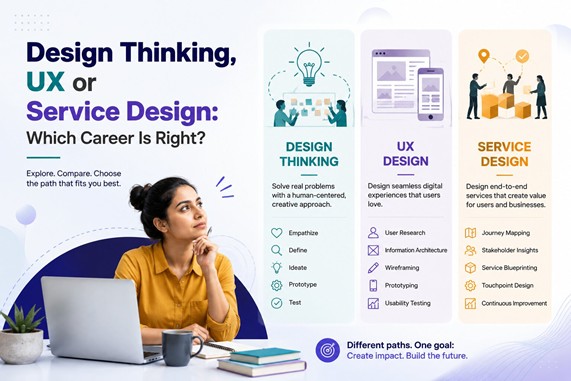
Design Thinking vs UX Design vs Service Design is a common career comparison for students, designers, product professionals, consultants, educators, and career switchers. These three fields are connected, but they are not the same. Design Thinking is a problem-solving approach, UX Design focuses on digital user experience, and Service Design improves complete service journeys across people, processes, systems, and touchpoints.In 2026, companies in India are hiring professionals who can understand users, improve digital products, simplify services, and build better customer experiences. This creates strong opportunities across UX design, product design, service design, innovation consulting, customer experience, EdTech, healthcare, fintech, BFSI, SaaS, and startups.For learners exploring design-led careers, the right path depends on one question: Do you want to solve broad business problems, design digital products, or improve end-to-end service experiences? Programmes such as JGU Online’s M.Sc. in Design Thinking, Innovation & Strategy can help learners build a structured foundation in innovation, human-centred problem-solving, and strategic design.

Quick Answer

Design Thinking is best for people who want to solve business, product, and innovation problems. UX Design is best for people who want to design websites, apps, platforms, and digital products. Service Design is best for people who want to improve complete customer journeys across online and offline touchpoints. 

If you want a design career with clear entry-level hiring, UX Design is often the most direct path. If you want consulting, strategy, innovation, or leadership roles, Design Thinking can be broader. If you want to work on healthcare, banking, hospitality, education, public services, or complex customer journeys, Service Design can be highly valuable.

Key Takeaways

Important Definitions

Question

Direct Answer

Which is better: Design Thinking or UX Design?

UX Design is better for digital product careers; Design Thinking is broader for innovation and strategy.

UX Design vs Service Design: what is the difference?

UX focuses on digital experiences; Service Design improves full service journeys.

Which has a better salary in India?

UX and product design roles have clearer salary benchmarks; service design and innovation roles can pay well at senior levels.

Is Service Design a good career?

Yes, especially in healthcare, BFSI, consulting, hospitality, education, and public services.

Can non-designers learn Design Thinking?

Yes. It is useful for managers, founders, educators, marketers, and consultants.

Which path is best for beginners?

UX Design is usually the easiest entry point because roles, portfolios, and tools are more defined.


Important Definitions

Design Thinking: Design Thinking is a human-centred problem-solving framework used to understand people, define problems, create ideas, prototype solutions, and test them.
UX Design: UX Design, or User Experience Design, improves how users interact with a digital product such as an app, website, dashboard, software platform, or tool.
Service Design: Service Design improves the full experience of a service across people, processes, physical spaces, digital channels, communication, and support systems.
User Research: User research studies user needs, pain points, behaviours, motivations, and decision-making.
Journey Mapping: Journey mapping visualises the steps a user or customer takes before, during, and after using a product or service.
Prototyping: Prototyping creates a simple version of an idea so it can be tested before full development.

Difference Between Design Thinking, UX Design and Service Design
The main difference is scope. Design Thinking is the method, UX Design is a digital product discipline, and Service Design is a complete service-system discipline.

Factor

Design Thinking

UX Design

Service Design

Main focus

Solving problems creatively

Improving digital user experience

Improving full service journeys

Scope

Broad

Product or interface-focused

End-to-end experience-focused

Output

Ideas, concepts, prototypes, strategies

Wireframes, flows, prototypes, usability improvements

Service blueprints, journey maps, process redesign

Best for

Innovation, consulting, strategy

Apps, websites, SaaS, digital platforms

Healthcare, banking, education, hospitality, public services

Common roles

Innovation consultant, design strategist, business designer


UX designer, product designer, UX researcher

Service designer, CX strategist, experience designer

Beginner-friendly?

Medium

High

Medium

Portfolio type

Problem-solving case studies

UX/UI and research case studies

Journey maps, service blueprints, system maps


M.Sc. in Design Thinking, Innovation & Strategy Career Path A Design Thinking career is suitable for people who enjoy solving unclear problems, facilitating workshops, understanding users, testing ideas, and connecting creativity with business strategy.

Common roles include innovation associate, design strategist, business designer, product strategist, customer experience consultant, and innovation consultant. These roles are common in consulting firms, startups, EdTech companies, corporates, NGOs, public policy teams, and innovation labs.

Design Thinking professionals use tools such as Miro, FigJam, Notion, Figma, Canva, ChatGPT, Claude, Gemini, and Microsoft Copilot. Useful frameworks include Double Diamond, Design Sprint, Lean Startup, Jobs-to-be-Done, Business Model Canvas, Value Proposition Canvas, OKRs, and stakeholder mapping.

Best fit: Choose Design Thinking if you want a broad career in innovation, strategy, product discovery, business problem-solving, or consulting.

UX Design Career Path

A UX Design career path is one of the most structured routes into design-led work. UX designers research users, create wireframes, design user flows, test prototypes, and improve how people use digital products.

Common UX roles include UX designer, product designer, UI/UX designer, UX researcher, interaction designer, information architect, and usability analyst. UX Design is widely used in IT services, SaaS, fintech, e-commerce, EdTech, healthcare apps, enterprise software, and startups.

UX beginners should learn Figma, FigJam, Miro, usability testing, wireframing, prototyping, design systems, accessibility basics, UX writing, and product analytics. A strong UX portfolio should show the problem, research, user journey, design decisions, prototype, testing, and improvement.

Best fit: Choose UX Design if you want a practical, digital product-focused career with clearer entry-level job roles.

Service Design Career Path

A Service Design career focuses on improving the complete experience of a service. Unlike UX Design, which often focuses on digital screens, Service Design looks at the entire system: users, staff, processes, communication, physical spaces, policies, tools, and support.

Service designers create journey maps, service blueprints, stakeholder maps, process maps, experience principles, and service improvement plans. They are hired in healthcare, banking, insurance, hospitality, education, government services, retail, aviation, consulting, and large enterprises.

For example, UX Design may improve a hospital appointment app. Service Design improves the full hospital appointment journey: booking, arrival, registration, waiting, consultation, billing, reports, follow-up, and support.

Best fit: Choose Service Design if you enjoy systems thinking, customer journeys, operations, research, and improving real-world services.

Design Thinking vs UX Design Salary in India

Salary depends on role, experience, portfolio, city, industry, and company type. UX and product design roles usually have clearer salary data because companies hire directly for these titles. Design Thinking and Service Design roles may appear under innovation, consulting, customer experience, product strategy, or service design titles.

Career Level

UX / Product Design

Design Thinking / Innovation

Service Design / CX

Entry level

₹3-8 LPA

₹4-8 LPA

₹4-9 LPA

Mid level

₹8-18 LPA

₹8-20 LPA

₹9-22 LPA

Senior level

₹18-35 LPA+

₹18-40 LPA+

₹20-45 LPA+

Lead / Consultant

₹30-60 LPA+

Project or leadership-based

Project or leadership-based


The highest salaries usually go to professionals who combine design thinking with product strategy, AI tools, analytics, business impact, communication, and leadership.

Skills Required for All Three Careers

Skill

Design Thinking

UX Design

Service Design

User research

Important

Essential

Essential

Problem framing

Essential

Important

Essential

Wireframing

Helpful

Essential

Helpful

Prototyping

Important

Essential

Important

Journey mapping

Important

Important

Essential

Service blueprinting

Helpful

Limited

Essential

Business strategy

Essential

Helpful

Important

Visual design

Limited

Important

Helpful

Facilitation

Essential

Helpful

Essential

Data and analytics

Helpful

Important

Helpful


The strongest professionals are not limited to one tool. They understand users, business goals, technology constraints, and measurable outcomes.

Industries Hiring Design Thinking, UX Design and Service Design Professionals

Industry

Hiring Need

SaaS and IT

Product design, enterprise UX, dashboards

Fintech and BFSI

Digital onboarding, trust, payments, lending journeys

EdTech

Learning experience, student journeys, engagement

Healthcare

Patient journeys, health apps, hospital service design

Consulting

Innovation strategy, workshops, service transformation

E-commerce

Search, checkout, retention, conversion

Public sector

Citizen services, accessibility, policy delivery

Hospitality and travel

Booking, service journeys, customer experience

Startups

Product-market fit, MVPs, user testing

Manufacturing

Product usability, after-sales service, customer support


Expert Insights
Design Thinking is a mindset and method. UX Design is a specialised product skill. Service Design is a system-level experience skill. The best career choice depends on the kind of problems you enjoy solving.

If you like screens, apps, digital flows, and visual interaction, UX Design is the clearest path. If you like workshops, strategy, innovation, and business problems, Design Thinking is stronger. If you like complex journeys involving people, processes, and operations, Service Design is the better fit.

Industry Statistics and Future Outlook
India’s design-led career market is being shaped by digital transformation, AI adoption, product-led growth, fintech expansion, EdTech growth, healthcare digitisation, and customer experience competition. 

Hiring reports in 2026 show strong demand for AI and technology-adjacent roles, which benefits design professionals who can work on AI products, digital platforms, automation workflows, and user adoption.

The future of all three careers is hybrid. UX designers will need product and data skills. Service designers will need business and operations understanding. Design thinkers will need AI literacy, facilitation, and measurable strategy outcomes.

Common Mistakes
Many beginners confuse Design Thinking with UI design. Design Thinking is broader and focuses on problem-solving. Another mistake is choosing UX only because it looks creative, without understanding research, testing, accessibility, and product logic.

Service Design beginners often struggle because they do not build enough real-world case studies. Service Design portfolios should show systems, stakeholders, journeys, backstage processes, and improvement opportunities, not only screens.

Best Practices
Start with one clear path. Choose UX if you want faster entry into digital product roles. Choose Design Thinking if you want broader innovation and strategy roles. Choose Service Design if you want to improve complex services across industries.

Build a portfolio with 3-4 strong case studies. Use real problems from apps, hospitals, schools, banks, local businesses, NGOs, or public services. Show research, insight, decisions, prototypes, testing, and impact.

Real-World Examples
A fintech company may hire a UX designer to reduce loan application drop-offs. A hospital may hire a service designer to improve patient discharge journeys. A consulting firm may hire a design thinking specialist to run innovation workshops. An EdTech company may hire a product designer to improve learner engagement. A government project may use service design to simplify citizen access to public services.

Frequently Asked Questions

1. What is the difference between Design Thinking, UX Design, and Service Design?
Design Thinking is a problem-solving approach. UX Design applies user-centred design to digital products such as apps, websites, and platforms. Service Design improves full service journeys across people, processes, systems, and touchpoints. In simple terms, Design Thinking is the method, UX Design is digital-product focused, and Service Design is service-system focused.

2. Which career is better: Design Thinking, UX Design, or Service Design?
UX Design is better for beginners who want clearer job roles and digital product opportunities. Design Thinking is better for innovation, consulting, and strategy-focused careers. Service Design is better for people who enjoy systems, customer journeys, and operational improvement. The best choice depends on your strengths, portfolio, and preferred industry.

3. Is UX Design better than Design Thinking for career growth?
UX Design can offer faster early career growth because job titles, tools, portfolios, and hiring pathways are more defined. Design Thinking can offer broader long-term growth in consulting, innovation, leadership, and strategy. UX is stronger for digital product roles, while Design Thinking is stronger for cross-functional problem-solving and business transformation.

4. What skills are required for Design Thinking, UX Design, and Service Design careers?
All three careers require user research, problem framing, journey mapping, prototyping, testing, communication, and stakeholder management. UX Design also needs wireframing, interaction design, accessibility, and design systems. Service Design needs service blueprinting, systems thinking, and operations understanding. Design Thinking needs facilitation, ideation, business modelling, and innovation strategy.

5. Which industries hire Design Thinking, UX Design, and Service Design professionals?
Industries hiring these professionals include IT, SaaS, fintech, BFSI, healthcare, EdTech, consulting, e-commerce, public services, hospitality, manufacturing, mobility, and startups. UX is strongest in digital product companies, Service Design is strong in service-heavy industries, and Design Thinking is useful across innovation, strategy, and transformation teams.

6. What is the salary difference between Design Thinking and UX Design in India?
UX Design salaries are easier to benchmark because companies hire directly for UX and product design roles. Entry-level UX roles may start around ₹3-8 LPA, while senior product designers can cross ₹20-35 LPA. Design Thinking roles vary more because they appear under innovation, strategy, consulting, product, or business design titles.

7. Can I switch from UX Design to Service Design?
Yes, UX designers can switch to Service Design by learning journey mapping, service blueprinting, stakeholder mapping, systems thinking, operations, and customer experience strategy. UX experience helps because both fields use user research and prototyping. The switch becomes easier when your portfolio shows end-to-end journeys, not only screens.

8. Can non-designers build a career in Design Thinking?
Yes, non-designers can build a career in Design Thinking. Professionals from business, engineering, education, healthcare, marketing, public policy, and consulting can use design thinking to solve user and organisational problems. They should build skills in research, facilitation, problem framing, prototyping, storytelling, and business model thinking.

Conclusion
Design Thinking vs UX Design vs Service Design is not about choosing the “best” field overall. It is about choosing the field that matches the problems you want to solve. UX Design is best for digital product careers. Service Design is best for improving complete service journeys. Design Thinking is best for broader innovation, strategy, and business problem-solving.

For learners who want a structured foundation in human-centred innovation, JGU Online’s M.Sc. in Design Thinking, Innovation & Strategy can be considered as a pathway to build design thinking, innovation, and strategy capabilities.

Final verdict: choose UX Design if you want a clear digital design career, choose Service Design if you enjoy systems and customer journeys, and choose Design Thinking if you want broader innovation and strategy opportunities.