


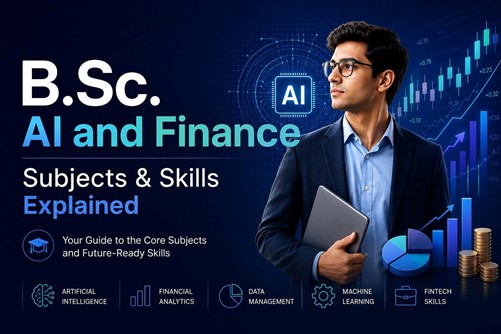
B.Sc. AI and Finance Syllabus Explained: Subjects, Skills, and
Career Scope
Finance today runs on data, algorithms and automation, not just spreadsheets. That is why programmes like the B.Sc. in Artificial Intelligence & Finance Online from JGU Online exist. If you are wondering about the B.Sc. AI and finance subjects and skills you will actually study, and whether a complete beginner can keep up, this guide explains everything, from Python and machine learning basics to financial modelling and student projects.
Key Takeaways
· A B.Sc. in Artificial Intelligence and Finance blends core finance subjects with programming, statistics and machine learning.
· Python is the main coding language, taught from scratch, so no prior programming experience is required.
· Machine learning powers real finance applications such as fraud detection, credit scoring and algorithmic trading.
· Financial modelling skills help you forecast cash flows, value companies and support investment decisions.
· Students build hands-on projects like stock-price predictors, risk dashboards and loan-default models.
· JGU Online delivers the programme fully online, making it flexible for students and working learners alike.
What Subjects Are Taught in a B.Sc. in AI and Finance?
A B.Sc. in AI and Finance covers three connected areas: core finance subjects such as accounting, economics and investments; technology subjects such as Python programming, statistics and machine learning and integrated subjects such as fintech, financial analytics and algorithmic trading that combine both worlds. In the B.Sc. in Artificial Intelligence and Finance at JGU Online, early semesters build foundations and later semesters apply them to real financial problems.
Finance Foundations
Expect financial accounting, corporate finance, economics, banking and investment analysis, which teach you how money moves, how firms are valued and how markets behave.
AI and Technology Core
Here you study Python programming, statistics and probability, machine learning and data
visualisation, building the quantitative skills for undergraduates that modern finance employers actively seek.
Where the Two Meet
The most exciting subjects sit at the intersection: fintech, financial modelling, algorithmic trading and risk analytics, where you use code and data to answer real financial questions.
Do I Learn Coding in a B.Sc. in AI and Finance?
Yes. Coding, primarily in Python, is a core part of the degree. However, the programme assumes no prior experience. You start with basic syntax and logic, then gradually move to data analysis libraries and machine learning tools, so beginners can build confidence step by step.
Python for Finance Students: Why It Comes First
Python for finance students is the natural starting point because it is beginner-friendly and used across the financial industry. You will learn libraries such as pandas for handling data, NumPy for calculations, and Matplotlib for charts. By the second year, tasks like cleaning a stock dataset or automating a report feel routine.
How Is Machine Learning Used in Finance?
Machine learning in finance means training computer models on historical data so they can detect patterns and make predictions. Banks use it to flag fraudulent transactions, score credit applications, forecast prices, power robo-advisors and manage risk, often faster and more consistently than manual
analysis. The degree covers machine learning basics for beginners in a structured way: you first learn how models are trained and tested, then apply regression and classification to financial datasets, such as predicting loan defaults from past credit records. JGU Online teaches these concepts with finance context from day one, so you practise on market data and transaction records rather than abstract examples.
What Is Financial Modelling and Why Is It Important?
Financial modelling is the process of building a structured, usually spreadsheet- or code-based, representation of a company or investment. It projects revenues, costs and cash flows to answer questions like what a business is worth or whether a project will be profitable. It is a core skill for analysts, bankers and consultants. Strong financial modelling skills turn raw numbers into decisions. You learn to build three-statement models, discounted cash flow (DCF) valuations and scenario analyses, and to enhance them with Python, for instance by simulating how an investment performs under different market conditions.
Is a B.Sc. in AI and Finance Difficult for Beginners?
The degree is challenging but very manageable for beginners. It does not require prior coding knowledge or advanced mathematics beyond school level. Concepts are introduced gradually, and consistent weekly effort matters far more than natural talent in programming or maths. A common misconception is that AI degrees suit only engineering students. In reality, the online B.Sc. in Artificial Intelligence & Finance is designed for commerce, science and humanities students alike, and JGU Online supports learners with recorded lectures, doubt-clearing sessions and mentor guidance.
Eligibility:
- Applicants who have completed Class 12 (or equivalent) with 50% marks
- Must have studied at least one of the following subjects:
- Mathematics
- Business Mathematics
- Business Studies
- Gov. Issue ID Proof (Aadhar Card Passport) for International Learners.
Selection Criteria:
Admission to the programme is based on a multi-step evaluation process:
Submit the Application Form
· Complete and submit the online admission form.
FACTA Assessment
· Appear for FACTA (Finance Aptitude and Critical Thinking Assessment) conducted by the university.
Personal Interview
· Shortlisted candidates are invited for a personal interview.
Final Selection
· Admission is granted based on overall performance across the assessment and interview.
What Projects Do Students Build in an AI and Finance Degree?
Projects are where the B.Sc. AI and finance subjects and skills come together. Typical student projects include:
· Stock-price prediction models using historical market data and regression techniques.
· Fraud detection systems that classify suspicious transactions from payment datasets.
· Loan-default prediction models built on real-world credit data.
· Personal finance and budgeting dashboards created with Python visualisation tools.
· Company valuation models combining DCF analysis with scenario testing. These projects become portfolio pieces that often impress recruiters more than grades alone.
Benefits and Career Opportunities After the Degree
Career Outcomes
· Investment Banking Analyst
· Risk and Compliance Analyst
· FinTech Product Analyst
· Portfolio and Investment Analyst
· Chartered Accountant (AI-focused)
· Data Scientist (Finance)
· AI Consultant for Financial Services
· Machine Learning Engineer
· Risk Modeling Professional
Studying online with JGU Online adds flexibility: learn from anywhere, balance the degree with internships, and later progress to the M.Sc. in Artificial Intelligence and Finance for advanced specialisation. If your interest leans more towards global accounting standards than AI, JGU Online also offers an Online B.Com in International Accounting & Finance, so you can choose the path that fits your career goals.
Frequently Asked Questions (FAQs)
1. What subjects are taught in a B.Sc. in AI and Finance?
Core subjects include financial accounting, corporate finance, economics, statistics, Python programming, machine learning, financial modelling and fintech, along with applied projects.
2. Do I need coding experience before joining?
No. Python for finance students is taught from absolute basics in the first year, and difficulty increases gradually, making the programme fully beginner-friendly.
3. How is machine learning used in finance?
It powers fraud detection, credit scoring, price forecasting, algorithmic trading and portfolio management, enabling faster, data-driven decisions.
4. Is the B.Sc. in Artificial Intelligence & Finance Online recognised?
Yes. JGU Online programmes are delivered by O.P. Jindal Global University, a UGC-recognised Institution of Eminence, and online degrees hold the same validity as on-campus degrees.
5. Can I switch to accounting instead of AI?
Yes. If pure finance appeals more, the B.Com in International Accounting & Finance online from JGU Online focuses on global accounting, taxation and reporting standards.
Start Your AI and Finance Journey with JGU Online
The future of finance belongs to graduates who can code, model and analyse. The B.Sc. in Artificial Intelligence & Finance Online from JGU Online gives you those skills through a flexible, beginner-friendly online degree. Explore the curriculum, check your eligibility and apply today to build a career at the intersection of technology and finance.