


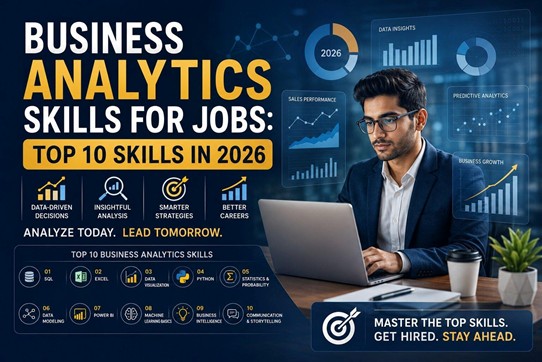
Top 10 Business Analytics Skills Employers
Want in 2026 (Beyond Excel and SQL)
Excel and SQL still
matter but in 2026, they are the entry ticket, not the differentiator.
The business analytics skills in demand in 2026 have shifted
decisively toward AI-augmented analytics, decision science, and the ability to
convert data into decisions leader’s trust.
Recruiters at consulting
firms, banks, and product companies now screen for storytelling, prescriptive
thinking, and domain depth alongside technical basics.
This guide from JGU
Online breaks down the ten skills that matter most this year, why employers
value them, and how working professionals can build each one including through
an Online MBA in Business Analytics.
Key Takeaways
· Employers
in 2026 hire for decision impact, not dashboard output.
· Data
storytelling and stakeholder communication now rank alongside technical skills.
· Prescriptive
analytics and decision science separate senior analysts from report builders.
· AI-augmented
analytics tools make GenAI fluency a baseline expectation, not a bonus.
· Python
remains valuable but knowing when to use it matters more than syntax mastery.
· Structured
programmes like the JGU Online MBA in Business Analytics build these skills
together, not in isolation.
What Are the Most In-Demand Business Analytics Skills in 2026?
The most in-demand
business analytics skills in 2026 are data storytelling, decision science,
prescriptive analytics, AI-augmented analytics, Python, BI tools such as Power
BI and Tableau, cloud data platforms, domain knowledge, data ethics and
governance, and stakeholder influence.
Employers want analysts
who convert data into confident business decisions, not just reports.
Here is a closer look at
each skill and why it made the list.
1. Data Storytelling
What is data
storytelling, and why does it matter for analysts? It is the craft of framing
analysis as a narrative context, insight, recommendation so decision-makers
actually act on it.
A model no one
understands changes nothing. In 2026, hiring managers routinely test data
storytelling skills in case interviews, asking candidates to present findings
to a “CFO” rather than simply explain a chart.
2. Decision Science
Decision science skills
combine analytics with behavioural economics and judgement under uncertainty.
Instead of asking what does the data say? decision scientists ask what should
we do, given risk, incentives, and trade-offs?”Employers value this framing
because most business problems are decisions, not datasets. It is also the
fastest route from analyst to strategic advisor.
3. Prescriptive Analytics
Descriptive analytics
explains what happened; predictive analytics estimates what will happen;
prescriptive analytics skills recommend what to do next using optimisation,
simulation, and scenario modelling.
As analytics budgets
face greater scrutiny, prescriptive skills pair naturally with knowing how to measure analytics ROI combination
employers actively seek in senior analyst and consultant roles.
4. AI-Augmented Analytics
AI-augmented analytics
using GenAI copilots, automated insight generation, and natural-language
querying is now a baseline expectation in most analytics teams. Analysts who
can prompt, validate, and critique AI outputs work dramatically faster than
those who cannot.
Crucially, employers
want judgement: knowing when the copilot is wrong matters more than knowing how
to use it.
5. Python (Yes, Still)
Do business analysts
need to know Python in 2026? For most roles, yes at a working level. You do not
need software-engineer depth, but comfort with pandas, notebooks, and API calls
lets you go beyond BI-tool limits and collaborate credibly with data
scientists. Helpfully, GenAI assistants have lowered the learning curve, making
Python more accessible than ever.
6. BI and Analytics Tools for Managers
Which analytics tools
should MBA students learn first? Start with Power BI or Tableau for
visualisation, SQL for querying, and Excel for quick modelling then layer in
Python. These analytics tools for managers cover most day-to-day work, and they
form the core stack taught in the JGU Online MBA in Business Analytics.
7. Cloud Data Platform Fluency
Business data now lives
in cloud platforms like Snowflake, BigQuery, and Databricks not on laptops.
Analysts do not need to administer these systems, but understanding how modern
data warehouses, pipelines, and governance layers work makes you more effective
and far more credible with engineering teams.
8. Domain Knowledge
How important is domain
knowledge for business analytics jobs? Increasingly decisive. Two analysts with
equal technical skills are separated by who understands the industry banking
regulation, retail margins, healthcare workflows.
This is why specialised
programmes such as MBA in Business Analytics with AI or PG
programmes in Business Analytics help professionals combine analytical
expertise with industry-specific knowledge, making them more competitive in the
job market.
9. Data Ethics and Governance
With AI embedded in everyday
analytics workflows, employers need people who understand bias, privacy
regulation (including India’s DPDP Act), and responsible AI practice.
Governance is no longer a compliance afterthought it is a hiring criterion,
particularly in finance, healthcare, and consulting.
10. Stakeholder Influence and Soft Skills
What soft skills do
analytics leaders need? Structured communication, negotiation, expectation
management, and the confidence to say the data doesn’t support that.
Analytics leaders spend
more time aligning people than writing queries. These skills compound with
every promotion and they are the hardest to learn from tutorials alone.
How JGU Online Helps You Build These Skills
The Online MBA in Business Analytics from JGU
Online (O.P. Jindal Global University) is designed around this exact skill
map.
The curriculum combines
Python, SQL, and BI tools with decision science, machine learning, data
storytelling, and leadership modules so you build technical and strategic
skills together. Because the programme is fully online and UGC-entitled,
working professionals can upskill without a career break.
Eligibility
· Bachelor's degree in any discipline with minimum
50% aggregate score from a recognized university.
· Govt. Issued ID Proof (Aadhar card + 1 More
Additional Govt. Issued ID Proof for Indian and International Applicants) Valid
Passport mandatory for foreign applicants.
Selection Criteria
· Review of Documents Uploaded
· Relevant Work Experience
Career Outcomes
· Business Analyst
· Management Consultant
· HR Analyst
· Marketing Analyst
· Supply chain Analyst
· Risk Analyst
· Financial Analyst
Frequently Asked Questions
Is Excel still relevant for business analysts
in 2026?
Yes, Excel remains useful
for quick modelling and ad-hoc analysis. However, it is now a baseline skill.
Employers expect it by default and differentiate candidates on data
storytelling, prescriptive analytics, and AI-augmented analytics capabilities
instead.
What is the difference between predictive and
prescriptive analytics?
Predictive analytics
forecasts what is likely to happen, using statistical and machine learning
models. Prescriptive analytics goes further, recommending the best action
through optimisation and scenario analysis. Prescriptive skills are rarer,
which is why they command higher salaries.
Can I learn business analytics without a
technical background?
Yes. Most business
analytics roles need applied, not engineering-level, technical skills.
Structured programmes such as the JGU Online MBA in Business Analytics and AI
teach Python, SQL, and BI tools from scratch, alongside the business context
that employers value most.
Which is better for analytics careers: an MBA
or a technical master’s?
It depends on your goal.
An Online MBA in Business Analytics suits professionals targeting
management, consulting, and strategy roles, while a technical master’s suits
specialist paths such as AI in finance. JGU Online offers both routes for
working professionals.
Build the Skills Employers Are Hiring For
The gap between report
builders and decision drivers is widening and 2026 is the year to move to the
right side of it.
Explore the Online MBA in Business Analytics at JGU Online to build data storytelling, decision science, and AI-augmented analytics skills with a globally ranked university entirely online, while you work. Visit jguonline.edu.in to apply.